![Arborgreen - LGreen - RGB - Lrg.png]](https://learn.arborgreen.net.au/hs-fs/hubfs/AG%20-%202023%20Branding%20Collateral/AG%20-%20Logo%20(Light%20Green)/Arborgreen%20-%20LGreen%20-%20RGB%20-%20Lrg.png?height=40&name=Arborgreen%20-%20LGreen%20-%20RGB%20-%20Lrg.png)
The leader is truly and ultimately responsible for everything. That is Extreme Ownership, the fundamental core of what constitutes an effective leader in the SEAL Teams or in any leadership endeavour.
On any team, in any organization, all responsibility for success and failure rests with the leader. The leader must own everything in his or her world. There is no one else to blame. The leader must acknowledge mistakes and admit failures, take ownership of them, and develop a plan to win.
When subordinates aren’t doing what they should, leaders that exercise Extreme Ownership cannot blame the subordinates. They must first look in the mirror at themselves. The leader bears full responsibility for explaining the strategic mission, developing the tactics, and securing the training and resources to enable the team to properly and successfully execute.
If an individual on the team is not performing at the level required for the team to succeed, the leader must train and mentor that underperformer. But if the underperformer continually fails to meet standards, then a leader who exercises Extreme Ownership must be loyal to the team and the mission above any individual.
If underperformers cannot improve, the leader must make the tough call to terminate them and hire others who can get the job done. It is all on the leader.
Total responsibility for failure is a difficult thing to accept, and taking ownership when things go wrong requires extraordinary humility and courage. But doing just that is an absolute necessity to learning, growing as a leader.
Extreme Ownership requires leaders to look at an organization’s problems through the objective lens of reality, without emotional attachments to agendas or plans. It mandates that a leader set ego aside, accept responsibility for failures, attack weaknesses, and consistently work to a build a better and more effective team.
Such a leader, however, does not take credit for his or her team’s successes but bestows that honour upon his subordinate leaders and team members.

Not bad teams, bad leaders
When leaders who epitomize Extreme Ownership drive their teams to achieve a higher standard of performance, they must recognize that when it comes to standards, as a leader, it’s not what you preach, it’s what you tolerate.
Once a culture of Extreme Ownership is built into the team at every level, the entire team performs well, and performance continues to improve, even when a strong leader is temporarily removed from the team.
The recognition that there are no bad teams, only bad leaders facilitates Extreme
Ownership and enables leaders to build high-performance teams that dominate on any battlefield, literal or figurative.
Be a Believer
In order to convince and inspire others to follow and accomplish a mission, a leader must be a true believer in the mission.
If a leader does not believe, he or she will not take the risks required to overcome the inevitable challenges necessary to win. And they will not be able to convince others
In many cases, the leader must align his thoughts and vision to that of the mission.
Once a leader believes in the mission, that belief shines through to those below and above in the chain of command.
Check the Ego
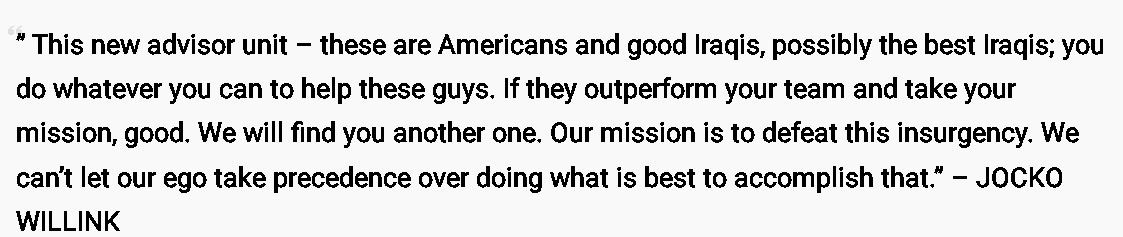
Your ego is an obstacle to good leadership because it prevents you from exercising extreme ownership of the team’s performance. Egos can also prevent team members from cooperating and working towards an overarching goal.
Egos are a challenge anytime two people interact. A person with an outsized ego is more likely to hold an inflated sense of their abilities. They are also less likely to take responsibility for a mistake. Finally, they are unlikely to sympathize with individuals they see as below them. People with excessive egos tend to make decisions without consulting anyone else and put other people’s requests low on their priority lists.
Ego clouds and disrupts everything: the planning process, the ability to take good advice, and the ability to accept constructive criticism. It can even stifle someone’s sense of self-preservation. Often, the most difficult ego to deal with is your own. Be confident, not cocky.
STORY
Babin relays a story of one of his clients: this was a manager faced with a superintendent subordinate who had more knowledge and experience than him. The subordinate had taken action—without running it first by the manager—that would cost the company lots of money.
Needless to say the manager was very upset. His ego had taken a hit because the subordinate had not cleared the action with him. With Babin’s help, the manager was able to check his ego and realize that the action may not have been deliberately done to hurt him or to see how much the subordinate could get away with. The manager said, “I’m sure he [the subordinate] thought he was doing the best for the immediate situation as it presented itself.” Over the ensuing conversation, Babin and the manager came to the conclusion that the subordinate acted in good faith, yet was unaware of the big picture. Thus, the subordinate’s action, taken without running it first by the manager, had cost the company hundreds of thousands of dollars.
It was the responsibility of the manager to explain the overall plan and mission to all subordinates, so that they could see the impact of their actions.
Had Babin and the manager not spoken, the manager would have likely confronted the subordinate and it would have resulted in a clash of egos. Instead, Babin recommended to the manager to take Extreme Ownership and not point fingers, but take full responsibility. Here’s what Babin said to the manager:
“This isn’t his fault, it’s yours. You are in charge, so the fact that he didn’t follow procedure is your fault. And you have to believe that, because it’s true. When you talk to him [the subordinate] you need to start the conversation like this: ‘Our team made a mistake and it’s my fault. It’s my fault because I obviously wasn’t as clear as I should have been in explaining why we have these procedures in place and how not following them can cost the company hundreds of thousands of dollars. You are an extremely skilled and knowledgeable superintendent. You know more about this business than I ever will. It was up to me to make sure you know the parameters we have to work within and why some decisions have got to be run through me. Now, I need to fix this so it doesn’t happen again.’ ”

Cover and Move:
It is the most fundamental tactic, perhaps the only tactic. Put simply, Cover and Move means teamwork. All elements within the greater team are crucial and must work together to accomplish the mission, mutually supporting one another for that singular purpose.
It falls on leaders to continually keep perspective on the strategic mission and remind the team that they are part of the greater team and the strategic mission is paramount. Each member of the team is critical to success, though the main effort and supporting efforts must be clearly identified. Alternatively, when the team succeeds, everyone within and supporting that team succeeds. Every individual and every team within the larger team gets to share in the success. Accomplishing the strategic mission is the highest priority.
Simplify:
Simplifying as much as possible is crucial to success. When plans and orders are too complicated, people may not understand them. And when things go wrong, and they inevitably do go wrong, complexity compounds issues that can spiral out of control into total disaster. Plans and orders must be communicated in a manner that is simple, clear, and concise.
If your team doesn’t get it, you have not kept things simple and you have failed. You must brief to ensure the lowest common denominator on the team understands.
Prioritize and Execute:
On the battlefield, countless problems compound in a snowball effect, every challenge complex in its own right, each demanding attention. But a leader must remain calm and make the best decisions possible.
Even the most competent of leaders can be overwhelmed if they try to tackle multiple problems or a number of tasks simultaneously. The team will likely fail at each of those tasks. Instead, leaders must determine the highest priority task and execute. When overwhelmed, fall back upon this principle: Prioritize and Execute.
A particularly effective means to help Prioritize and Execute under pressure is to stay at least a step or two ahead of real-time problems. Through careful contingency planning, a leader can anticipate likely challenges that could arise during execution and map out an effective response to those challenges before they happen.
To implement Prioritize and Execute in any business, team, or organization, a leader must:
- Evaluate the highest priority problem.
- Lay out in simple, clear, and concise terms the highest priority effort for your team.
- Develop and determine a solution, seek input from key leaders and from the team where possible.
- Direct the execution of that solution, focusing all efforts and resources toward this priority task.
- Move on to the next highest priority problem. Repeat.
Don’t let the focus on one priority cause target fixation. Maintain the ability to see other problems developing and rapidly shift as needed.
Decentralize Command:
Human beings are generally not capable of managing more than six to ten people, particularly when things go sideways and inevitable contingencies arise. Teams must be broken down into manageable elements of four to five operators, with a clearly designated leader. Those leaders must understand the overall mission, and the ultimate goal of that mission.
Junior leaders must be empowered to make decisions on key tasks necessary to accomplish that mission in the most effective and efficient manner possible. Teams within teams are organized for maximum effectiveness for a particular mission.

Plan:
What’s the mission? Planning begins with mission analysis. Leaders must identify clear directives for the team. Once they themselves understand the mission, they can impart this knowledge to their key leaders and frontline troops tasked with executing the mission. A broad and ambiguous mission results in lack of focus, ineffective execution, and mission creep. To prevent this, the mission must be carefully refined and simplified so that it is explicitly clear and specifically focused to achieve the greater strategic vision for which that mission is a part. The mission must explain the overall purpose and desired result, or “end state,” of the operation.
The test for a successful brief is simple: Do the team and the supporting elements understand it?
The best teams employ constant analysis of their tactics and measure their effectiveness so that they can adapt their methods and implement lessons learned for future missions. Often business teams claim there isn’t time for such analysis.
But one must make time.
A leader’s checklist for planning should include the following:
- Analyze the mission. —Understand higher headquarters’ mission, Commander’s
- Intent, and endstate (the goal). —Identify and state your own Commander’s
- Intent and endstate for the specific mission.
- Identify personnel, assets, resources, and time available.
- Decentralize the planning process. —Empower key leaders within the team to analyse possible courses of action.
- Determine a specific course of action. —Lean toward selecting the simplest course of action. —Focus efforts on the best course of action.
- Empower key leaders to develop the plan for the selected course of action.
- Plan for likely contingencies through each phase of the operation.
- Mitigate risks that can be controlled as much as possible.
- Delegate portions of the plan and brief to key junior leaders. —Stand back and be the tactical genius.
- Continually check and question the plan against emerging information to ensure it still fits the situation.
- Brief the plan to all participants and supporting assets. —Emphasize Commander’s Intent.
- Ask questions and engage in discussion and interaction with the team to ensure they understand.
- Conduct post-operational debrief after execution. —Analyze lessons learned and implement them in future planning.
Leading Up and Down the Chain of Command:
Any good leader is immersed in the planning and execution of tasks, projects, and operations to move the team toward a strategic goal. Such leaders possess insight into the bigger picture and why specific tasks need to be accomplished.
This information does not automatically translate to subordinate leaders and the frontline troops. Junior members of the team—the tactical level operators— are rightly focused on their specific jobs. They must be in order to accomplish the tactical mission. They do not need the full knowledge and insight of their senior leaders, nor do the senior leaders need the intricate understanding of the tactical level operators’ jobs. Still, it is critical that each have an understanding of the other’s role. And it is paramount that senior leaders explain to their junior leaders and troops executing the mission how their role contributes to big picture success.
As a leader employing Extreme Ownership, if your team isn’t doing what you need them to do, you first have to look at yourself. Rather than blame them for not seeing the strategic picture, you must figure out a way to better communicate it to them in terms that are simple, clear, and concise, so that they understand. This is what leading down the chain of command is all about.
Leading up the chain of command requires tactful engagement with the immediate boss (or in military terms, higher headquarters) to obtain the decisions and support necessary to enable your team to accomplish its mission and ultimately win. To do this, a leader must push situational awareness up the chain of command.
Leading up the chain takes much more savvy and skill than leading down the chain.
Leading up, the leader cannot fall back on his or her positional authority. Instead, the subordinate leader must use influence, experience, knowledge, communication, and maintain the highest professionalism.
The major factors to be aware of when leading up and down the chain of command are these:
- Take responsibility for leading everyone in your world, subordinates and superiors alike.
- If someone isn’t doing what you want or need them to do, look in the mirror first and determine what you can do to better enable this.
- Don’t ask your leader what you should do, tell them what you are going to do.
Decisiveness and Uncertainty
Intelligence gathering and research are important, but they must be employed with realistic expectations and must not impede swift decision making that is often the difference between victory and defeat. Waiting for the 100 percent right and certain solution leads to delay, indecision, and an inability to execute.
Leaders must be prepared to make an educated guess based on previous experience, knowledge of how the enemy operates, likely outcomes, and whatever intelligence is available in the immediate moment.
Discipline Equals Freedom—The Dichotomy of Leadership
- A leader must lead but also be ready to follow.
- A true leader is not intimidated.
- A leader must be aggressive but not overbearing.
- A leader must be calm but not robotic.
- A leader must be confident, but never cocky.
- A leader must be brave but not foolhardy.
- Leaders must have a competitive spirit but also be gracious losers.
- A leader must be attentive to details but not obsessed by them.
- A leader must be strong but likewise have endurance, not only physically but mentally.
- Leaders must be humble but not passive.
- A leader must be close with subordinates but not too close.
- A leader has nothing to prove but everything to prove.
https://static1.squarespace.com/static/5ba335baf79392897a2bb39d/t/5bb1c4910d929713f2aba115/1538376850004/Extreme-Ownership-Book-Summary.pdf