![Arborgreen - LGreen - RGB - Lrg.png]](https://learn.arborgreen.net.au/hs-fs/hubfs/AG%20-%202023%20Branding%20Collateral/AG%20-%20Logo%20(Light%20Green)/Arborgreen%20-%20LGreen%20-%20RGB%20-%20Lrg.png?height=40&name=Arborgreen%20-%20LGreen%20-%20RGB%20-%20Lrg.png)
Good to Great is the defining management study of our decade. Jim Collins and his team of 21 researchers spent five years analysing, interviewing and examining America’s top companies. They studied 1,435 Fortune 500 companies and found only 11 that were able to make the leap to success and hold on to that success for at least the next 15 years.
These 11 are the companies that have achieved truly enduring success. They are largely unremarkable companies such as Walgreens, Wells Fargo, Philip Morris and Kimberly-Clark, and they hail from a diverse range of industries. The surprise finding is that they all used a similar path in their transformation from an ordinary company to a stunning success story.
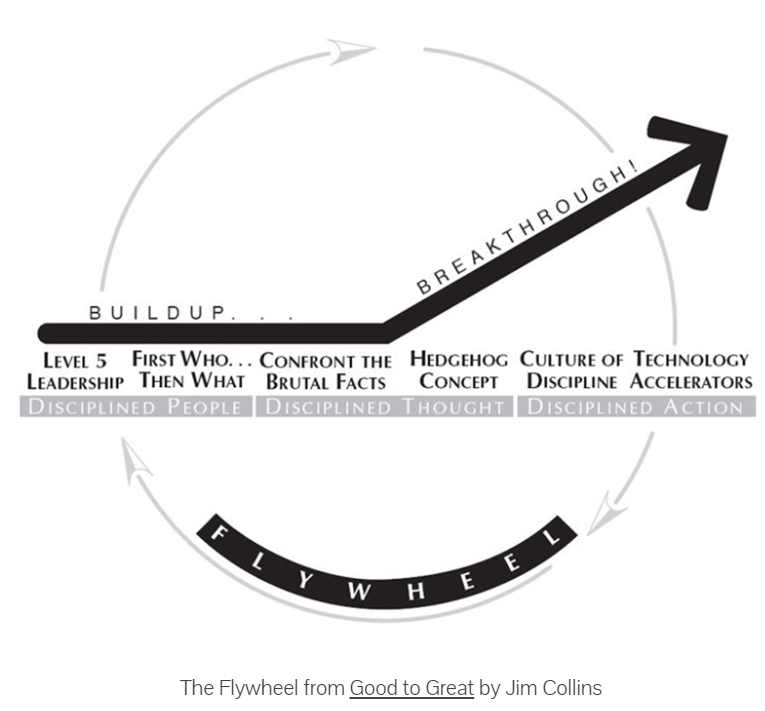
- Disciplined people: means getting the right people and keeping them focused on excellence.
- Disciplined thought: means being honest about the facts and avoid getting sidetracked.
- Disciplined action: means understanding what is important to achieve and what isn’t.
Good is the Enemy of Great
The book is about being great, not merely good. Good is the enemy of great. Many people and companies settle for good because it’s easier. Many companies don’t even try to be great. There’re not striving to be the best in the industry. This opens the door to competitors. Being the best means there is absolutely no room for mediocre thinking. It’s the same in our lives. Few people lead great lives. This is because they’re happy with living a good life.
Disciplined People
Level 5 Leadership
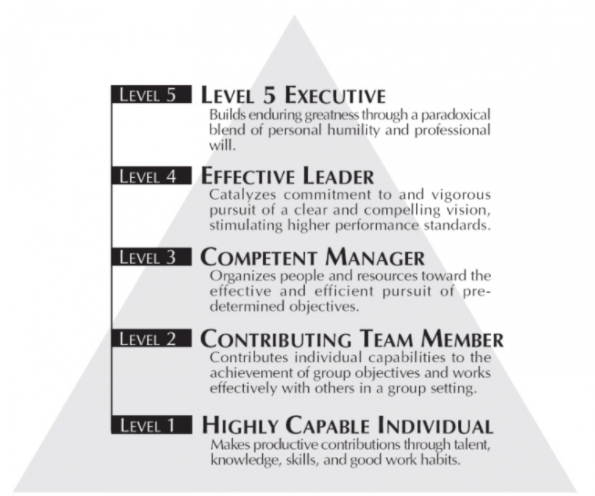
If you think about an organizational hierarchy, the lowest level of leadership is the Highly Capable Individual. These are people who contribute using their skills, know-how and good work habits.
Moving a step up the hierarchy, the next level is a Contributing Team Member. These are people who are able to use their skills and knowledge to help their team succeed.
The next level is Competent Manager. These managers are capable of organizing their team to efficiently reach pre-determined objectives.
Level 4 is Effective Leaders. This is where the majority of leaders can be found. They are able to create the commitment from their team to vigorously pursue a clear and compelling vision. They’re also able to create a high-performing team.
Finally, we reach Level 5 Leadership. These are the great leaders. They have the abilities of the other four levels plus a unique combination of will and humility. And it is this combination that makes them great.
The behaviors of Level 5 Leaders that set them apart include:
- Paradox: They are ambitious, but their ambition is for the organization to excel rather than themselves. At the same time, they tend to be modest about what they personally contribute and are self-effacing.
- Driven: They are fanatically driven, obsessed even, to produce exceptional results on a sustainable basis. The key word here is sustainable. This isn’t the result of a one-off heroic effort.
- Build successors: They build successors to be even more successful. This is in contrast to level 4 leaders who will sometimes set up their successors for failure to make themselves look good.
- Share praise: They share the praise amongst the team when things go well.
- Take blame: They are happy to take the blame when things go wrong. By sharing the praise and taking the blame they make their team extremely loyal and committed to them.
- Normal people: They never have larger than life personalities or celebrities.
- Come from within the organization: This is because their greatness comes from quiet hard-work, rather than heroic acts.
You should try to develop these traits if you want to become a Level 5 Leader.
To encourage and find Level 5 Leaders in your organization you can:
- Look for great results without an individual claiming the credit. You may just already have a Level 5 Leader working for you.
- Practice the Good to Great concepts. This will encourage the development of Level 5 Leaders.
- Hire from within. Avoid the temptation to recruit external talent.
- Invest in personal development, coaching and mentoring for your team.
First Who......Then What
How many times have you started a process by first setting a new direction, vision and strategy for your company? Typically your next step would then be deciding how many people should be committed, who they should be and how you can motivate them behind this new strategy and direction. They are logical steps, but in this order you will not achieve a breakthrough transformation. Companies that have transformed themselves from good to great do the exact opposite.
Good to great companies did not achieve success by figuring out which direction to drive the bus then getting the people to take it there. They flipped the process. First, they made sure they had the right people on the bus (and go: the wrong people off). Then they decided which direction to go.
Simply by beginning with question of ‘who’, you solve three common problems.
- You will find it easier to adapt to unexpected change.
- You will destroy issues surrounding people's motivation and management because the right people don’t need to be constantly managed by others. They are motivated by being the early creator of something great.
- If you have the right people on your bus to begin with, you can always figure out how to take it somewhere great. If you have the wrong people every direction will be fruitless. Great vision without great people will never produce a great company.
You may already think you know the importance of finding great people. All companies would like to hire great people. But be aware it’s not just about employing them to join your team or project first. Do it before you decide your direction.
BUILD DEPTH
To achieve sustained, long-term success, you need to build a depth to talent in your company. Once you have this talent, you can always assign them some responsibility in deciding the company’s path. Most companies fall into the trap of having one ‘genius’ leader who sets the direction for everyone else. They will typically be surrounded by ‘helpers’, who may be talented and highly capable of contributing to decisions on direction, but they are rarely asked for ideas or their ideas are rarely accepted.
Avoid the ‘genius’ with 1,000 helpers’ model and you will avoid the fate of many companies. These companies enjoy success during the genius’ period of employment, only to enjoy spectacular failure after their departure. You need executives who will argue and debate with their boss, who will always fight to find the best answers, not blindly accept authority.
Just as importantly, at the end of each debate or discussion, you need people who can move past loyalties and politics to unite fully behind the team decision.
DARWIN SMITH
Darwin Smith was appointed CEO of Kimberly-Clark in 1971 when it was known as a stodgy old paper company.
Over the previous 20 years its stock had been lagging by 36 percent compared to the general market. There was violent opposition to the board’s appointment of Smith, who was the company’s mild-mannered in-house lawyer. But throughout his 20 year reign as CEO, Smith proved them all wrong.
During this time, Kimberly-Clark underwent a stunning transformation, outperforming the market by 4.1 times and beating fearsome competitors to become the number one paper-based consumer product company in the world. It’s one of the best examples any executive can have of how to take a good company and make it great. Yet few of us have ever heard the name Darwin Smith. He never cultivated executive celebrity status, instead preferring to spend his time with plumbers and electricians. But his shyness and lack of pretension was teamed with his fierce resolve.
That resolve was used to execute the most important decision in Kimberly-Clark history: sell the paper mills. Smith and his team had decided to move away from the company’s traditional core business of coated paper, because it was doomed. They aimed to move into the competitive arena of the consumer paper products industry, competing head-on with Procter & Gamble. One board member called it the gutsiest move a CEO had
ever made.
The media and fund managers called it stupid and dumped the stock. Smith held his resolve. Fast forward 25 years and Kimberly-Clark had bought out one of its major competitors and seized market ownership of six out of Procter and Gamble’s eight major product Categories.
In retirement, Smith said of his achievements: ‘I never stopped trying to become qualified for the job.’ Smith did whatever was needed to make the company great. He was the ultimate level five leader.
IT’S NOT ABOUT THE PAY
As long as you are rational and reasonable with your employee’s pay, you’ll find that compensation has little effect on whether or not your company is transformed from good to great. Looking at all the good to great companies in history, executive compensation has never been one of the reasons for their greatness. If you have the right people in the first place, you’ll find that they naturally set high standards for themselves.
They will naturally do everything they can to achieve their goals because they can’t imagine settling for less, regardless of the incentive system. In your business, if you’re using pay to induce behaviour, you’ve got the wrong people. The aim of your compensation and incentive system should always be to get the right talent on your bus, and keep them there.
THE BEST TEAM EVER
Famed US bank Wells Fargo lives and breathes the ‘first who, then what’ philosophy. Ex-CEO Dick Cooley began the legacy in the 1970s when he built, according to investment guru Warren Buffett, the best management team in the finance industry. Cooley did this by hiring top talent whenever and wherever he came across it, even though he often didn’t have a specific job to offer.
He knew the US banking industry was about to go through gut-wrenching change, but he never assumed to know how the change would come or how he would respond. When change did inevitably come, no company handled it better than Wells Fargo. The entire banking industry fell 59 percent behind the general stock market, while Wells Fargo coolly outperformed the market more than three times over.
From the executive team assembled by Cooley, nearly every single person went on to become CEO of major companies such as Bankers Trust, Westpac and Bank of America. Get the best people on board, help them to become the best managers in your industry, and graciously accept that they will probably be headhunted by other companies. It is your people that will transform your company from good to great, not your strategies.
RIGOROUS, NOT RUTHLESS
We all know it’s hard work building a great company. Looking at the culture of each great company, you’ll find that they have one thing in common. They’re all rigorous cultures. To cultivate a rigorous culture, you need your people to hold themselves and others (especially upper management) to the highest standards at all times. Be aware that this is different to a culture of ruthlessness.
Ruthless companies hack and cut at everything (including people), especially in hard times. The difference is that when you apply rigour to your company instead of ruthlessness, your best people can fully concentrate on their work at hand. They don’t feel the pressure of constantly worrying about their jobs.
Out of the 11 good to great companies, six reported zero layoffs in the 10 years before their breakthrough.
Four others recorded only 1-2 people laid off during this same period. Endless restructuring has never been the way to a breakthrough performance.
There are four ways you can ensure rigour in your company’s culture:
- If you’re hesitating, don’t hire – keep looking.
Your company’s growth will not come from a new market, technology or product. It will come first and foremost from your ability to bring in and keep the right people. If you’re hesitating about hiring someone, they’re already the wrong person. - As soon as you know you need to change your people – act.
If one of your team members needs to be tightly managed, you’ve made a mistake in hiring them. While you should be training, guiding, teaching and leading your people, you should not feel the need to closely manage their day-to-day work. We all know what happens when you keep the wrong person on the bus: you try to build systems for their shortcomings.
Only after a mountain of valuable time and energy has been spent on this person might the problem finally conclude by a resignation or other action. Meanwhile your best people have been compensating for this person’s inadequacies. In the worst-case scenario, the wrong people might even drive your best people away from sheer frustration and exhaustion! Act quickly.
But make sure you get the wrong people off the bus, not the right ones. Sometimes the right people for your company can just be sitting in the wrong positions. Change their seats. Now. - Your best people should be working on your biggest opportunities, not your biggest headaches.
Star employees create value out of nothing.
So when your best people want to work on an unproven concept in a part of your business with little growth or promotion prospects, let them. They realise that rectifying previous headaches can only make a business good. Creating and growing opportunities will make it Great. - Don’t sell off your best people along with your problems.
When you have decided to change your company direction, you may need to sell or stop some areas of your business. But you still need the good people within that area to stay with your company. People will be less likely to oppose change or sell off if they know they always have a place on your bus. Make sure they know you won’t sell them off along with your problems.
Disciplined Thought
Confront the Brutal Facts
When you are faced with turbulent change, you have two choices: you can confront the brutal facts of reality and change your actions in response, or you can stick your head in the sand.
If you have Level 5 Leadership, and you have the right people, then the whole organization is able to put company performance ahead of their own ego. This enables you to confront the brutal facts, without losing faith that the company will be successful.
CLIMATE OF TRUTH
Here are four basic practices you can use to create a climate where the truth is always heard in your company:
- Lead with questions, not answers.
Instigate informal meetings where groups of managers and employees get together with no set agenda or action items. Start with a question such as ‘What’s currently on your mind?’, ‘What should we be worried about?’ or ‘Can you help me to understand?’. Through these informal forums, all your current realities can come to the surface quickly and be dealt with before they cause bigger problems. Asking questions will give you the best possible insights into your company. - Engage in dialogue and debate, not persuasion or coercion.
Start a culture of intense and ongoing dialogue in your firm. Discussion and meetings are not a way for you to give people ‘their say’ so they ‘buy in’ to your predetermined direction. It is the engagement of different people in your company’s search for the best answers that will turn it from good into great. - Examine and autopsy failure, without blame.
Don’t be afraid of blemishing your track record with failures. Encourage everyone in your company to have the same fearlessness because when people are not afraid of failure, they won’t try to cover it up. In this type of climate, the truth is more often heard. In closely examining failure you are learning how to do better next time. Joe Cullman, CEO of Philip Morris, said of his company’s decision to buy the 7UP company:
"I will take responsibility for this bad decision."
But we will all take responsibility for extracting the maximum learning from the tuition we’ve paid.’ Instead of hiding the disastrous mistake, Philip Morris executives commonly bring it up in interviews; they’ve spent hours autopsying the decision, and no one ever apportions blame onto anyone else.
KEEPING THE FAITH
Admiral Jim Stockdale was the highest-ranking US officer held captive in the ‘Hanoi Hilton’ POW camp during the Vietnam War. Stockdale was imprisoned for eight long years and tortured over 20 times. He never had a set release date and had good reason to doubt if he would live beyond the war. Nevertheless, he set about doing everything he could to improve the conditions for other prisoners.
He helped people deal with torture by implementing a system for information disclosure when the torture sessions became too much.
He created a way of communicating, to reduce the feeling of isolation for those in solitary confinement, through a series of tap codes (for example, tap-tap equals the letter a). Stockdale was one of the few POWs who made it through to the end of the war because he never lost faith.
The people who didn’t make it out in the end were the optimists. The ones who believed they were going to get out by Christmas, or Easter. These were the ones who didn’t have the discipline to properly confront the most brutal facts of their reality. They died from disappointment
All good to great companies display the same tenacity as Jim Stockdale. They keep faith that they will succeed in the end, and simultaneously, confront the truth about their current reality. By adopting this same behaviour everyday in your company, you can dramatically increase the likelihood of consistently making winning decisions. - Build your own ‘red flag’ mechanisms
Find a way to ‘red flag’ any piece of information that is crucial to your business’s performance. Access to information is no longer a source of competitive advantage. It’s about how you identify what information is important to your business. In the same way that McDonald’s knows the second it exceeds its set level of costs or efficiencies per unit, your business must be able to recognise shortcomings and raise the red flag the second it happens. The sooner the flag is raised, the sooner that problem can be dealt with. When you are building a red flag mechanism into your business, make it loud and attention grabbing. Something that you just can’t ignore.
The benefits of confronting the brutal facts include:
- The organization becomes more resilient.
- People become excited about the chance to take on a challenge that seems impossible.
- It can create duality. One the one hand people accept the brutal facts. On the other, they maintain the faith that the company will ultimately be successful. Even if it takes many years.
- It dampens charismatic leaders. The brutal reality is more important than how a leader thinks the market should behave.
- Leaders will be fact led rather than personality led.
- It keeps motivation high. The reality is that pretending the realities of the marketplace don’t exist will sap everyone’s motivation. They’ll just be going through the motions.
In summary, confronting the brutal facts means its fine to have an ambitious destination in mind, as long as you continually adapt your plan every day as new brutal facts emerge.
THE HEDGEHOG CONCEPT
THE PERFECT HEDGEHOG
Walgreens is the perfect example of a hedgehog company. Walgreens was a largely anonymous pharmaceutical company before it began its growth run that would eventually exceed respected leaders such as GE, Merck, Coca-Cola and Intel. It had one simple, unifying hedgehog concept: To be the most convenient pharmacy with a high profit per customer visit. That’s it. That’s the strategy Walgreens used to outperform the market from 1975 to 2000 by over 15 times!
Once it had decided on this simple concept, Walgreens executed it with fanatical consistency. It implemented a systematic procedure to close down inconvenient locations and set up stores in more convenient, high traffic areas. If there was a great corner location available, even just half a block away from an existing Walgreens store, the company would shut the good location to opt for the great one. Even if it cost $1 million to break the lease. Even if convenience meant opening nine stores in a 2km radius.
The company cultivated a discipline of striving for increased profit per customer visit. They kept adding high-end services, like one-hour photo developing, to increase this profit per visit. This increased profit and provided it with more cash for opening more stores in highly populated areas. This led to more customer visits and more profit per visit. Walgreens accelerated its profit cycle and consistently beat its competitors by sticking to its hedgehog concept using excellence and imagination.
Sounds simple, doesn’t it? It is.
Is your company a hedgehog or a fox? Foxes are cunning, complex strategists who use their many small insights to plan sneaky attacks on the hedgehogs. Hedgehogs are slower. They have a single organising concept that unifies and guides all thinking.
No matter how complex an issue, it can be reduced to one hedgehog concept. Anything that doesn’t relate to that idea is irrelevant.
3 QUESTIONS TO UNCOVER YOUR HEDGEHOG CONCEPT
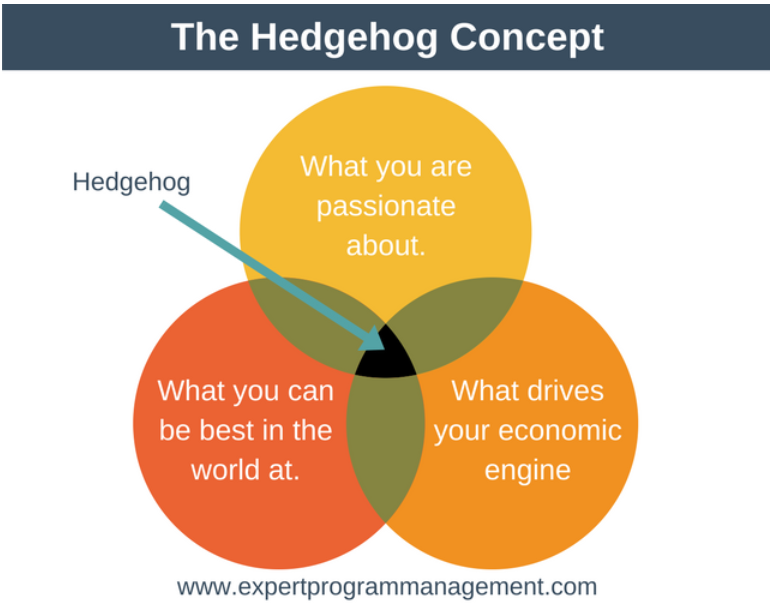
To uncover your company’s hedgehog concept, you need to understand and define your answers to three key questions about your business:
- What can you be the best in the world at?
Push yourself and others to understand more than just your company’s key competencies. Discover which of your competencies can exceed every other company.
The answer might be something that you don’t even do at the moment. - What drives your economic engine?
You need ongoing insight into the most effective and efficient ways that your company generates sustained cash f low and profitability. Good to great companies have a habit of uncovering their one denominator – whether is it profit per customer, per transaction or per unit. Know which measure has the single greatest affect on your net profit. - What are you and your people deeply passionate about?
Your company’s results will be driven harder and faster if you focus on activities that ignite your team’s passions. It’s not about stimulating or creating passion in people. The idea here is to really uncover what makes you and others in your company passionate.
Once you have answered all three questions, you can identify your hedgehog concept. It is the area where the three intersect. It is the one concept where you can be the best in the world, which ignites your passion and which makes economic sense. Implementing a concept that answers one or two of the questions might give you a good company, but only a concept that answers all three questions will make your company great.
After you have activated the hedgehog concept, continually insist on severe standards of excellence.
Once your company understands what it truly can be the best at, it needs to stick to it as if it is your only path to greatness.
Disciplined Action
A CULTURE OF DISCIPLINE
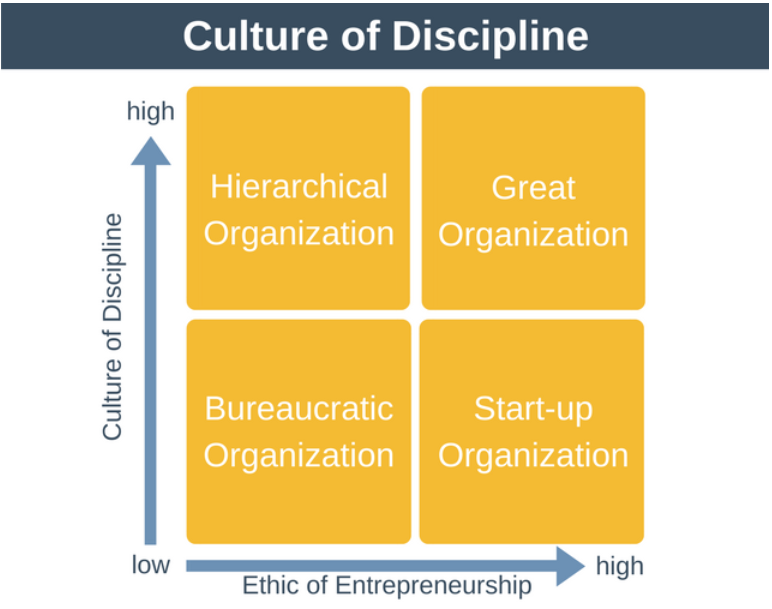
Few start-up companies ever enjoy sustained success. Even fewer become great companies. The reason for this is that their response to growth and success is almost always wrong. Your initial success will usually come from your skills as an entrepreneur - your imagination, creativity, proactivity and visionary zeal.
Once you start hiring more people, creating more systems and procedures and taking more order, things get chaotic. Problems arise from poor planning, poor customer service, cash flow management... the list goes on. Your response is usually to implement more professional management procedures and chains of command. Segmentation between ‘us’ and ‘them’ appears. By this time your entrepreneurial spirit has been killed. Creativity and innovation dies and mediocrity starts to grow. There is a better alternative.
To ensure your success carries on in the transition from a small to a large company, you need to dispel hierarchy. You must replace it with a culture of discipline. The potency of a discipline culture mixed with an entrepreneurial work ethic is a recipe for lasting results. It’s the driving force behind every good to great company, all of which were once a start-up.
DISCIPLINED ENTREPRENEURSHIP AT ABBOTT LABORATORIES
Everyone who works at health-care company, Abbott Laboratories, knows that any individual or company objectives they set for themselves might as well be set in stone. Plans, directions and actions might change, but never what you measure yourself against. No one in the company has the chance to adjust or finagle their initial objectives to make their performance look better. The only way performance is measured is relative to what they said why would achieve.
Abbott’s financial controller helped develop this culture of discipline by pioneering a new system he called Responsibility Accounting. Under this system, every cost, income and investment dollar was identified by the person responsible for that item. It was a rigorous method of accounting, which allowed no chance for covering up or finger pointing. But this discipline also allowed creativity and entrepreneurship to flourish.
Abbott was hailed for having the lowest percentage of administrative costs in its industry (by a significant margin) while simultaneously churning out new product success. If fact, they were so innovative that 65 percent of Abbott’s total revenue came from new products
alone. Plenty of new opportunities are considered daily, but Abbott employees maintain their fanatical discipline about saying no to anything that falls outside their hedgehog concept.
To support a culture of discipline you'll need to do five things:
- Build a culture where people are given freedom and responsibility within a framework of accountability.
You will free up your time if you put in place boundaries but let people decide for themselves how to act within those boundaries. All you’ll have to do is manage the system itself.
The best way to explain this is by using the example of an airline pilot. The pilot is guided by air-traffic control. But the pilot has ultimate responsibility within that system for the safety of the craft, its passengers, and its crew.
- Fill your company with self-disciplined people who set reachable goals and don’t hesitate in going to extreme lengths to achieve them.
In essence, this is about what we’re already covered: disciplined people, disciplined thought, and disciplined action. You need:
- The right people
- Confronting the brutal facts
- Following the Hedgehog Concept
- Then having the discipline to do what needs to be done to reach their objectives.
- Aim to achieve a culture of discipline not to be a tyrannical disciplinarian who achieves a culture of fear.
It’s not about driving your team relentlessly. It’s more about creating a culture where the team wants to achieve. Obviously, the Hedgehog Concept will help here as it keeps everyone focused -
Exercise extreme focus in adhering to your Hedgehog Concept
If you want to be average, start by trying to be great at lots of things. Good to Great companies keep focusing on their Hedgehog Concept and avoid everything else. Paradoxically, this can actually create more opportunities for growth than if you try to do everything.
Good to great companies not only have the discipline to do the right things, they have the discipline to stop doing any activities that are outside their concept. - Create a Stop-Doing list
Create a list of things you will stop doing so you can better focus on your Hedgehog Concept.
Change the way you plan. Instead of thinking which projects should get which people, think which projects support your Hedgehog Concept. Those that do get more funding. Those that don’t support the Hedgehog Concept get less funding or are scrapped.
Jim Collins' 20 Mile March Concept
Technology Accelerator
Good to Great companies think about technology in a different way. They will invest in new technology only if it serves their Hedgehog Concept.
The behaviors of Good to Great companies around technology include:
- They view technology in light of their Hedgehog Concept.
They ask if a new technology fits with their Hedgehog Concept. Only if there is a fit will they then invest in it. - They become pioneers of technology aligned to their Hedgehog Concept.
They use technology to speed up the momentum they already have. This is part of their disciplined approached to excelling at their Hedgehog Concept. - They use technology in unique ways.
Because they examine technology through the lens of their Hedgehog Concept they will often use technology in ways other than intended. - They maintain a balanced view of technology.
This means that they view how technology is used as being far more important than adopting the latest technology.
The Flywheel and Doom Loop
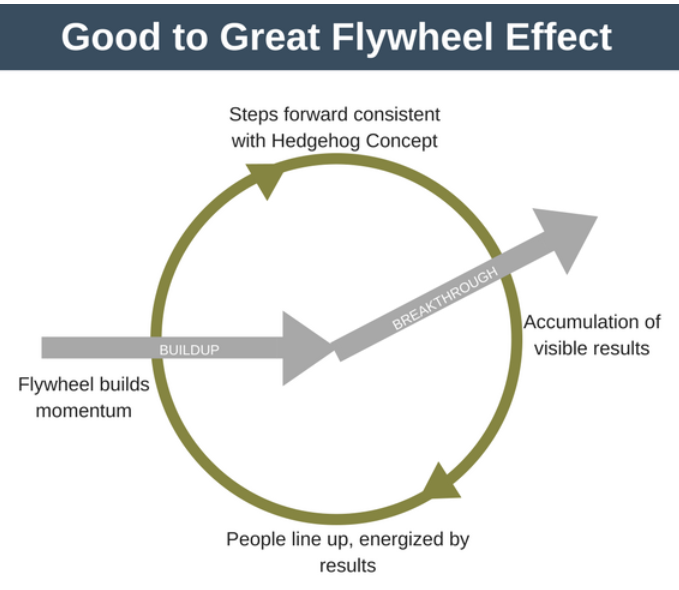
Breakthrough happens in companies as they go from good to great. It doesn’t happen at one point in time.
There is never a single defining action, program or strategy that prompts it. Breakthrough is a result of the cumulative process described here. Step by step, person by person and decision by decision, the wheel is turned.
Each turn of the wheel adds to its momentum until you find the wheel is taking on a life of its own. It is building daily results that add up to sustained and spectacular breakthrough results.
Every single company that has gone from good to great has achieved breakthrough by transforming itself. Yet none of these companies had a name for their transformations. Many of their senior executives weren’t even aware of the major transformation taking place until after the fact.
The lesson for all is that there is not one miracle moment. Although the media would have us believe success comes overnight, breakthrough will only happen in your company via a deliberate process of figuring out what you need to do, and then doing it again and again.
Fire Bullets, Then Cannonballs
You can recognise if you are reaching breakthrough by the signs that appear. There are five signs to look for:
- You have level five leaders in your company.
- You are disciplined in first deciding who to bring on before deciding which direction to go.
- You confront the brutal facts so you can clearly see what steps are needed.
- You demonstrate a discipline in sticking to your hedgehog concept.
- You maintain consistency over the long term. Each generation builds on the work of the ones before it.
You reach breakthrough via an organic evolutionary process, step by step.
Once you start to build a great company, the effects will begin to spill over into other areas of your life.
You may start to see all aspects of your life moving from good to great. It’s because in your company you are now starting to make decisions based on who you are with, rather than where you go. Which means you can always pick people you respect.
You’ll find that when you spend the majority of your time with people you love and respect, you increase the possibility of having a great life. When you live life alongside such people, you can have a great life regardless of where the bus, the company or life takes you.
You may not see breakthrough results in your business straight away, maybe not next year and perhaps not even the year after. But stay disciplined and maintain faith that it will happen. When it does, you’ll know you’ve had a hand in creating excellence. You will have made a contribution and just maybe you’ll glimpse the deepest of all satisfactions in life: knowing time has been well spent. You will have created not just a good business; you will have built a great company.
Jim Collins (Writer) explains the 4 stages and key concepts
Lean East provide a great pictorial overview
Expert Program Management sum up the book in videos