![Arborgreen - LGreen - RGB - Lrg.png]](https://learn.arborgreen.net.au/hs-fs/hubfs/AG%20-%202023%20Branding%20Collateral/AG%20-%20Logo%20(Light%20Green)/Arborgreen%20-%20LGreen%20-%20RGB%20-%20Lrg.png?height=40&name=Arborgreen%20-%20LGreen%20-%20RGB%20-%20Lrg.png)
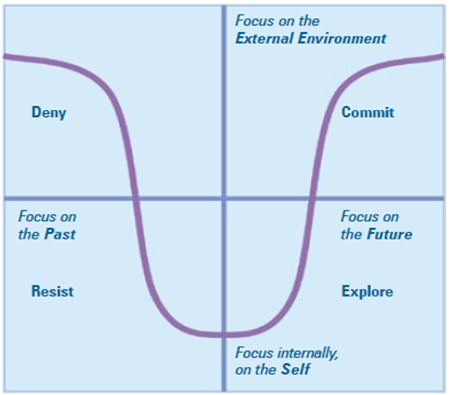
This change model describes the psychological process of adaption to change. Derived originally from studies of coping with bereavement and one’s own mortality it can also apply to comparatively minor changes, including changes in circumstance and routines at work. An understanding of how these stages affect us and others is invaluable when we are placed in a situation of driving change or having to cope with it. The model demonstrates that responses to change, which on the surface appear negative or undesirable, are in fact part of a necessary and therapeutic process.
Change occurs in and over time and this is indicated by the horizontal axis moving from the past (left) to the future (right).
The vertical axis represents our general awareness and suggests that as change progresses in time, we shift from a preoccupation with external circumstances to becoming more introspective and wrapped up in our thoughts and emotions before, once again, becoming attentive to our external circumstances.
The ‘U’ shaped curve represents ‘morale’ but also tracks the changes in psychological preoccupation, as described above. It can also be viewed as plotting the disempowering effect of change, with the left-hand quadrants of the curve representing increasing disempowerment and the upward curve of the right-hand quadrant representing re-empowerment
Working through the stages
Contentment/Denial
This is business as usual, the contentment/denial stage is easily identified even though the symptoms may take different forms ie. Ignoring the issue, minimizing the threat or trying to ignore it to name a few.
Often people at this stage are unconscious of the implications of the change, and will exhibit positive emotions towards the change.
At this stage, the role of the manager is to expose staff to the change as quickly as possible, create urgency and provide a visual journey to achieving the final vision.
Ensure support structures are in place and staff know how to utilize them, and training is readily available.
Resistance
Once the reality of the need to change sinks in and we can no longer deny the reality we move onto the next stage; resistance. Essentially, we accept that the change is inevitable but we are not happy about it. Either we have lost an existing reality or our loss is replaced by uncertainty about the future and our ability to deal with it.
The resistance is usually exhibited through emotional upsurges in the form of anger, frustration, anxiety, fear of the unknown and sometimes voice it out by opposing the change vociferously. It is during this stage when the organization witnesses a loss in productivity as well as the overall stability in the business environment due to this resistance.
Remember: People don't fear change, they fear loss.
As a manager you need to have empathy, truly get why they are upset and create activity to give voice to their emotions; but you have to face the resistance head on, and start to tackle it so the people and the organization can begin to move forward.
Exploration
The important thing to consider at this stage is that ‘exploration’ is tentative and fragile and moving too quickly may send a person backwards towards ‘resistance’. With this in mind, the behaviours associated at this stage are likely to involve finding out a little bit more of what change entails, or possibly, testing things out in a small way.
People tend to accept the change by this stage, and still have some negative feelings; causing a lot of questions to be raised.
The organization builds up its coping or adaptive mechanisms to tackle the resistance, focuses on the futuristic priorities/goals by empowering people and encouraging them for trying out new processes or testing things out gradually.
Remember: It takes time to cook a chicken; if you pull it out of the oven too early it is not cooked.
Tension needs to be deliberately maintained to create discomfort through out the process, especially at this stage, otherwise people will go back to the old way of doing things.
Help people to be comfortable being uncomfortable, be there to support them, and provide a sounding board for the myriad questions.
Create projects or large tasks between teams to keep the pressure on.
Commitment
This is the stage at which individuals are re-empowered. Essentially, it is important that efforts to commit to a new course of action are recognised in a positive manner and that ownership or responsibility for implementation is encouraged.