![Arborgreen - LGreen - RGB - Lrg.png]](https://learn.arborgreen.net.au/hs-fs/hubfs/AG%20-%202023%20Branding%20Collateral/AG%20-%20Logo%20(Light%20Green)/Arborgreen%20-%20LGreen%20-%20RGB%20-%20Lrg.png?height=40&name=Arborgreen%20-%20LGreen%20-%20RGB%20-%20Lrg.png)
Think differently about leadership:
I would imagine your organization looks like a pyramid with you, as the CEO, at the top and all the individual contributors at the bottom. In between are several layers of management.
When you think this way, the assumption is that everyone works for the person above them on the organizational ladder. As a result, managers are thought to be ‘responsible’ for planning, organizing, and evaluation everything that happens in the organization while their people are supposed to be ‘responsive to the directives of management.’
If you turn the pyramid upside down so that the top managers are at the bottom, there is a subtle, but powerful, twist in who is responsible and who should be responsible to whom.
Managers should work for their people…..If you think your people are responsible and that your job is to be responsive, you really work hard to provide them with the resources and working conditions they need to accomplish the goals you’ve agreed to. Your job is to roll up your sleeves and help them win.
You don’t have to work closely with all your people, only those who need help
Different Strokes
For
Different Folks
Three skills to be learnt:
- Learn how to diagnose the needs of the people you work with.
- Learn how to use a variety of leadership styles flexibly.
- Learn how to come to some agreements with them about the leadership style they need from you.
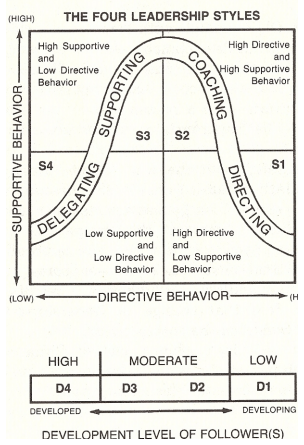
Four Basic Leadership Styles:
Directive Leadership: The leader provides specific direction and closely monitors task accomplishment
Used when new to the job.
‘my job is essentially to implement ideas….. he assigns me tasks and then works very closely with me….’
‘…he helps me plan what he wants me to do. He’s very clear about how he wants me to do it, and I always know where I stand and what he thinks about my performance because of the frequent meetings we have.’
Coaching: The leader continues to direct and closely monitor task accomplishment, but also explains decisions, solicits suggestions, and supports progress.
‘I get a lot of support, encouragement, and praise from the OMM. I find him listening to me and drawing me out. He also shares lots of information about the whole company so I can make better decisions…’
Supporting: The Leader facilitates and supports people’s efforts toward task accomplishment and shares responsibility for decision-making with them
‘…he insists that I consult with him before I implement any new personnel programs or policies. He wants to know exactly what I intend to do….always tells me his opinion and asks mine…I’m not always confident about my interpersonal skills. That’s why I welcome the OMM’s suggestions.’
Delegating: The leader turns over responsibility for decision-making and problem-solving to people.
‘…he literally leaves me alone, but it took him a while before he would do that…he’ come to respect and trust my judgement on technical matters…..now he says ‘keep me informed, but that’s your area-you run with the ball, you’re the technical expert around here’’
‘He doesn’t discuss things with me or tell me what to do or tell me how to solve a particular problem.’
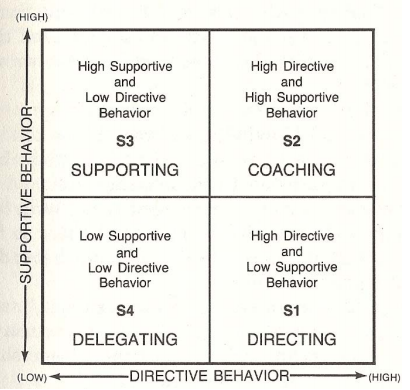
These four styles consist of different combinations of two basic Leadership behaviours that a manager can use to influence someone else;
Directive Behaviour: Structure, Organize, Teach and Supervise.
High on directive behaviour, low on supportive behaviour.
One way communication. You tell the person what, when, where, and how to do something and then you closely monitor the person on the problem or task.
Tell the person what the goal is and what a good job looks like, but you also lay out a step-by-step plan about how the task is to be accomplished.
You solve the problem. You make the decisions; the person carries out your ideas.
Supportive Behaviour: Praise, Listen, Ask, Explain and Facilitate.
High on supportive behaviour low on directive behaviour
You support your people’s efforts, listen to their suggestions and facilitate their interactions with others. And to build up their confidence and motivation, you encourage and praise. Help people reach their own solutions by asking questions that expand their thinking and encourage risk-taking. Don’t talk about how I would go about solving a particular problem or accomplishing a particular task.
Examples:
Directing: “Please go out now and tell Mrs. Johnson to get those people to move their conversation down the hall and when you’ve done that report back to me”
Supporting: “There’s noise in the outside office that’s bothering us – what do you think we could do about it?”
Coaching: “There’s a lot of noise in the outside office that’s bothering us. I think you should go outside and ask Mrs. Johnson to tell those people to move their conversation down the hall. Do you have any questions or suggestions?”
Delegating: “That noise outside is bothering us. Would you please take care of it?”
Coaching works best when disillusionment sets in. e.g.
- People find a task harder to master than they thought
- Lose interest in the task
- Drop in commitment maybe because they don’t think the rewards are going to be worth all the effort
- Maybe they aren’t getting the direction they need
- Or progress is so slow or non-existent that they lose confidence in their ability to learn to do the task well.
Listen to their concerns, provide perspective, and praise progress. And involve them in decision-making as much as you can to rebuild commitment.
Leadership style is a combination of directive and supportive behaviours
Directive Behaviour:
Involves: Clearly telling people what to do, how to do it, when to do it, and then closely monitoring their performance.
Supportive Behaviour:
Involves: Listening to people, providing support and encouragement for their efforts, and then facilitating their involvement in problem-solving and decision-making.
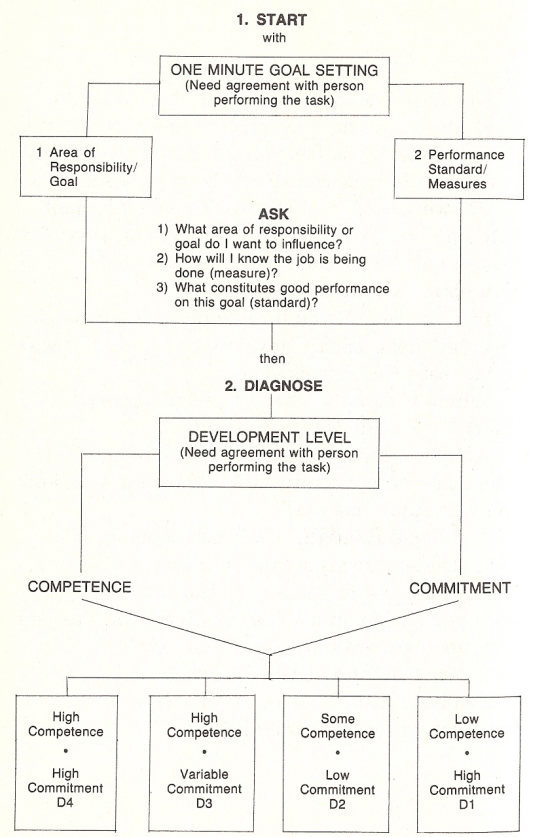
Diagnosing Development Level:
Knowing when to use which leadership style with which people
“a boss who was always telling his best people what to do because he knew his career depended on them, but they resented it because they already knew what to do. With his poorer performers, he didn’t respect them so he left them alone. Since they didn’t know what to do, they floundered.”
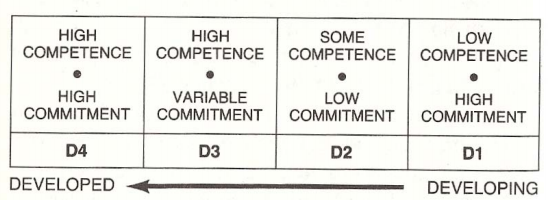
Anytime a person is not performing well without your supervision, it is usually a competence problem, a commitment problem, or both.
Competence is a function of knowledge and skills, which can be gained from education, training, and/or experience.
Commitment is a combination of confidence and motivation. Confidence is a measure of a person’s self-assuredness – a feeling of being able to do a task well without much supervision, whereas motivation is a person’s interest in and enthusiasm for doing a task well.
The four development levels are:
Matching leadership style to development style
Leadership styles appropriate for the various development levels
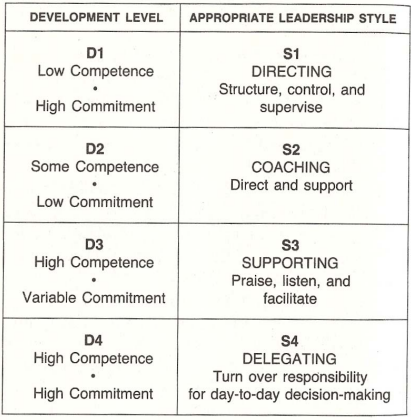
Directing (Style 1) is for people who lack competence but are enthusiastic and committed (D1). They need direction and frequent feedback to get them started.
Coaching (Style 2) is for people who have some competence but lack commitment (D2). They need direction and feedback because they’re still relatively inexperienced. They also need support and praise to build their self-esteem, and involvement in decision making to restore commitment.
Supporting (Style 3) is for people who have competence but lack confidence or motivation (D3). They do not need much direction because of their skills, but support is necessary to bolster their confidence and motivation.
Delegating (Style 4) is for people who have both competence and commitment (D4). They are able and willing to work on a project by themselves with little supervision or support.
Developing competence and commitment
Situational leadership ll
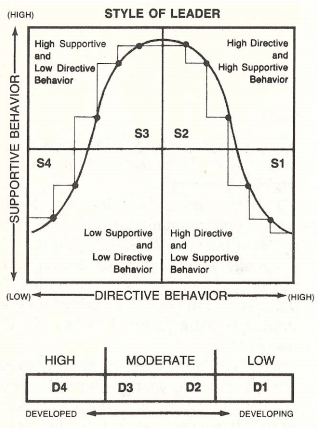
The performance curve shows that as development level moves from D1 to D4, the curve shows how a manager’s leadership style moves from S1 (directing) to S4 (delegating), with first an increase in support (S2), then a decrease in direction (S3), until eventually there’s also a decrease in support (S4). At D4 the person is able to direct and support more and more of his or her own work.
One Minute Praisings:
- Tell them what to do
- Show them what to do (model the behaviour)
Once people know what to do, they need to know what good performance looks like. They need to know what the performance standards are.
Show and tell are directive behaviours, training starts with directive behaviours, once goals and directions are clear then…
- Let them try
- Observe performance (when using directing style you need to stay in touch with the person and frequently monitor performance. YOU CAN EXPECT MORE IF YOU INSPECT MORE
- Parise progress
Style Of leader
Turning around Performance Problems
Reprimands are for D4’s and D3’s and occasionally D2’s, for those that are competent and committed but whose performance lately has not been up to par; Competent subordinates who have lost interest in a task.
Reprimands are not a training tool but a way to deal with motivation and attitude problems.
Before you reprimand someone, make sure you have the facts and see that there are no extenuating circumstances. Sometimes a decline in performance is caused by a drop in confidence – the job is more complicated than anticipated. When this happens you don’t reprimand; you provide support and encouragement, and if necessary direction.
One Minute Management & Situational leadership
A Review
|
GOALS start performance in the right direction and permit a manager to analyse a person’s competence and commitment (development level) to perform well. |
|
PRAISINGS foster improvements in the development level of individuals and permit a manager to gradually change his/her leadership style from more direction (directing) to less direction and more support (coaching and supporting) to less direction and less support (delegating). |
|
REPRIMANDS stop poor performance and may mean that a manager has to gradually move back from less direction and less support (delegating) to more support (supporting) or more direction (coaching and directing) |
These are the three secrets that make situational leadership such a dynamic model.
Share what you are doing
Share with staff the leadership style you will be using with each
Situational Leadership
Is Not
Something You Do To People
But
Something You Do With People
Partnering for Performance
There are three parts to performance review:
- Performance Planning
- The process starts with goal setting, identify three to five goals for the operation. Then develop performance standards for the next three to six months in relation to each goal, They’d be more involved in goal setting on tasks where they were experienced and knowledgeable, a D3 or D4. On the tasks where they were a D1 or D2, You’d take the lead.
- We’d agree on what a good job looks like. We’d also rewrite each goal so it was SMART.
- Employees need to know not only what they’re being held accountable for but also how performance is going to be measured and what a good job looks like.
- Day-to-Day Coaching
- Day-to-day coaching and counselling is about being responsive to the people you supervise. Once your people are clear on their goals, it’s your job to do everything you can to help them accomplish those goals so that when it comes to performance evaluation, they get high ratings
- Performance Evaluation
- You and me individually analyse your development level for each of the goals we agreed on and then to determine the leadership style you will need from me to succeed – that is, to perform at the desired level.
- Then when we meet again our task will be to agree upon your competence and commitment with respect to each goal and to agree upon the leadership style you need.
The rule is we’d agree on who goes first. It you go first, my job is to listen to your analysis and then before I can say anything, I have to tell you what I heard you saying. We do this because if one of us is more verbal than the other, that person will dominate the conversation.
“What happens if we cannot resolve our differences?”
With development-level analysis, the nod goes to your direct report. For example, if you feel you can be left alone, a D3 or D4, and I think you should be supervised, a D2 or D1, we would go along with your judgement – with one proviso. We’d have to agree on what the results will be for the next month so that we can both observe your performance.
Partnering for Performance Game Plan
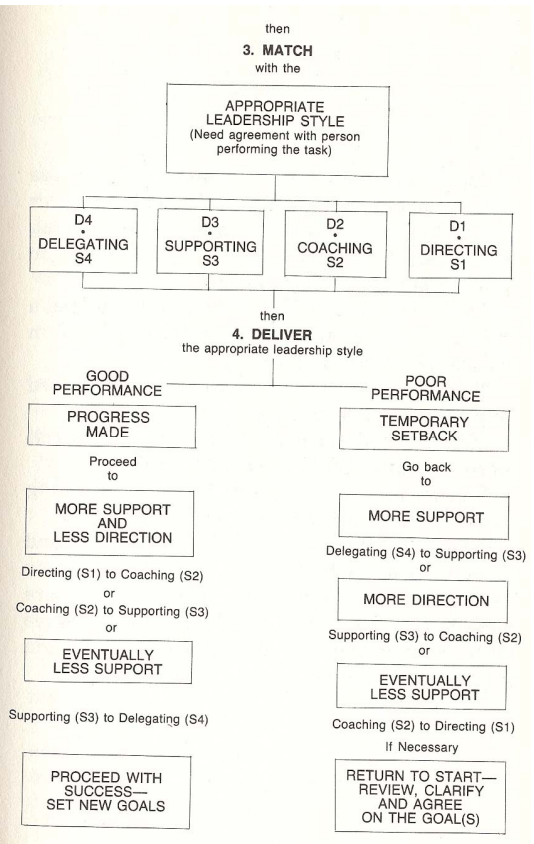
e.g. If we agree that you need a delegating style on a particular goal, you are in charge of the communication, the only rule is call early, not late. I don’t want any surprises.
If we agree you need a supporting style, we’d get out our calendars and I would ask, ‘whats the best way for me to recognize and praise the progress you are making – at lunch every week or so?’ If we agree to have lunch together, my role would be to listen and support your actions.
If we agree on a coaching style, I would be in charge, I might say, ‘let’s schedule two meetings a week for at least two hours to work on the goal yo need help with – how about Monday and Wednesday from one to three P.M.?’
With a directing style we’d be meeting even more frequently
Positive Assumptions about people
Always believe that your people have the potential to become high performers. The only thing that should fluctuate is the manager’s behaviour, depending on his or her people’s needs for direction and support.
Everyone
Is A
Potential
High Performer
Some People
Just Need
A Little Help
Along
The Way