![Arborgreen - LGreen - RGB - Lrg.png]](https://learn.arborgreen.net.au/hs-fs/hubfs/AG%20-%202023%20Branding%20Collateral/AG%20-%20Logo%20(Light%20Green)/Arborgreen%20-%20LGreen%20-%20RGB%20-%20Lrg.png?height=40&name=Arborgreen%20-%20LGreen%20-%20RGB%20-%20Lrg.png)
Let’s face it, the tired checklist of P’s that marketers have leaned on for decades – Pricing, Positioning, Promotion, Publicity, to name a few – just don’t work anymore.
There’s an important and exceptional P that has been missing. That P is the Purple Cow.
Cows, after you’ve seen one or two or ten, are boring. They may be perfect cows, attractive cows, cows with great personalities, but they’re still boring, and that makes them invisible. A Purple Cow, though… now that would be interesting, at least for a while. Purple Cow describes something phenomenal and exciting and flat-out unbelievable.
Every day consumers face a lot of boring, invisible, forgettable stuff – a lot of brown cows. But you can be sure they won’t forget a Purple Cow. It’s not a marketing gimmick or function that you can do to your product or service. Purple Cow is built in. It’s inherent or it’s not there at all.
Messages and advertisements broadcast through mass media are consistently ignored. The way we have sold for the last 50 years is dead.
The Purple Cow is all we’ve got – it’s our only hope. Read on to learn how to put a Purple Cow into everything you build and everything you do… to create something truly remarkable… to create marketing strategies that fly in the face of mass media… to create remarkable products that promote themselves and are worth marketing in the first place.
REMARKABLE OR INVISIBLE
Something remarkable is worth talking about, exceptional, new, worth noticing. It’s a Purple Cow – as opposed to an ordinary, invisible brown cow.
Remarkable marketers know that if it isn’t remarkable, it’s invisible. Remarkable marketing is the art of building things worth talking about right into your product or service. It’s part of the package, not the usual marketing add-on.
Why do you need a Purple Cow? Over the past two decades, the dynamic of marketing has been changing. The symbiotic relationship between consumer demand, ever increasing investments in marketing, TV advertising and ever-growing companies has broken down. Consumers have what they need, want very little, have no time to research your product, and are in the habit of ignoring your marketing messages.
We’ve created a world in which most products are invisible. TV and mass media are no longer your secret weapons. Traditional approaches are now obsolete. Your only hope is to stop advertising and start innovating.
THE MARKETING REVOLUTION
Before Advertising there was word of mouth. The best products got talked about, got a reputation and got purchased. During Advertising we stumbled on a magic formula: the combination of mass media, prosperity, consumer desire and television meant that if you advertised to every consumer, sales would go up.
After Advertising we’re almost back where we started – only word of mouth has been turbo-charged. Our new networks allow remarkable ideas to diffuse through segments of the population at rocket speed. The old stuff doesn’t work anymore. But the old stuff has been around so long (around half a century) that it seems like the only stuff.
We used to market to everyone. Now we’re dealing with a specific segment of consumers, and we need to understand them.
IDEA DIFFUSION
In Crossing the Chasm, Geoff Moore outlines how ideas diffuse through a population. They follow a curve, beginning with innovators and early adopters, grow into the majority, and eventually reach the laggards.
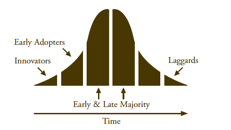
Old ways (During Advertising) were greedy and focused on the middle of the curve – the early and late majority.
They targeted everybody, which meant they targeted nobody, and bred the marketing habit of attempting to offend nobody. This worked for mass marketing. Mass marketing’s reign is now over, and we must breed new habits for new times.
The best business ideas are ones that spread. Now (After Advertising) we must focus on the left of the curve – the innovators and early adopters. If our product or service is remarkable, they will spread the word for us to the rest of the curve.
During Advertising, prospects were a resource to be strip- mined and then abandoned. There were plenty more where they came from. Now, right up there with innovation, prospects are our most valuable asset, to be nurtured and wooed, as they spread the word for us and bring us across the curve.
FIRST AND FOREMOST
The first person to market aspirin had a wide open market. It was a product that people all over the world had a need for, it was easy to try and immediately beneficial. Combine that with the mass impact of TV, and you had a magic formula. Obviously it was a big hit.
Today it’s not so easy. There are over a hundred different pain relief products to choose from in every drugstore.
Even if you had a much better product (in your opinion), you’d face a few problems. First, nearly everyone already has a pain reliever of choice. And secondly, you need people who buy pain relievers, people who want to buy a new one, and people who have the time or desire to listen to you. The vast majority will ignore you no matter how many ads you buy.
So your market goes from everyone down to an audience a tiny fraction of the size. These folks are hard to find, and they’re picky as well.
Being the first in the aspirin market was a great idea. Alas, that spot is taken.
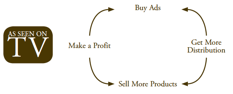
Seeing products on television used to be proof of quality, and so consumers would look for products on TV, thus perpetuating the TV-industrial cycle.
TV commercials are the most effective selling mechanism ever devised. But once they are ignored, their time is up. And it’s not just TV that’s fading. It is also newspapers, magazines – any form of media that interrupts any form of consumer activity. They don’t work anymore because people have stopped paying attention. They won’t listen to you anymore… but the right people will seek you out.
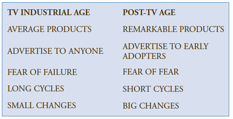
The old rule was: “Create safe, ordinary products and combine them with great marketing”
The new rule is: “Create remarkable products that the right people seek out”
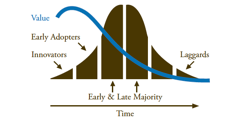
Yesterday’s marketers valued the volume of people they reached. This kept the focus on the middle of the curve, the early and late majority, which mass marketing typically targets.
In many markets today, the value of a group is not related to its volume – a group’s value is related to its influence.
Typically, the early adopters heavily influence the rest of the curve, so persuading this group is worth much more than wasting money persuading anyone else.
SNEEZERS WITH INFLUENCE
The majority of product sales come after those consumers willing to take a chance on something new have adopted the product. The early adopters make it safe for the early and late majority to try the product. After the early adopters embrace what you are selling, they sell it to the rest of the curve. And they sell it poorly.
The big insight here is that the bulk of the curve will ignore you, every time, no matter what you do. They will listen to their experienced peers, but they will ignore you.
It can be tempting to go for the big and profitable group at the centre of the curve, but that just doesn’t work anymore.
You need to design products that are remarkable enough to attract the early adopters. They must also be attractive and flexible enough that those adopters will have an easy time spreading the idea to the rest of the curve. Products are merely ideas. Ideas that spread are more likely to succeed than those that don’t. I call these idea viruses.
Idea viruses are spread, launched and maintained by sneezers. Sneezers are those experts who tell all their friends and colleagues about a new product or service on which they are perceived to be an authority. Marketing is no longer about making a product attractive or funny after it has been produced. It is now about designing products to be virus-worthy in the first place. Products that are worth talking about, get talked about.
" It is useless to advertise to anyone (except sneezers with influence) "
Not all customers are the same. 10% of your customers are likely to provide you with over 70% of your profits.
Identify the group that is most profitable, and the group that is most likely to sneeze. To get through to the mainstream, target only these two niche markets. If your product is remarkable, it will overwhelm this small market. This market is small enough that a few sneezers can give you the critical mass you need to create an idea virus. If you’re good and you’re lucky, after it dominates its niche, it will migrate to the masses.
Most people tend to think that the opposite of remarkable is “bad” or “mediocre.” This keeps them trapped.
The opposite of remarkable is very good.
Ideas that are remarkable are much more likely to spread than ideas that aren’t. Very good is boring. Very good is an everyday occurrence and hardly worth mentioning, definitely not worth telling your friends about. Are you making very good stuff? How fast can you stop?
OTAKU
The Japanese have some truly useful words. One that is most useful for marketers is otaku. Otaku describes a kind of passion about a subject – something that is a little more than a hobby and a little less than an obsession.
People read Fast Company magazine and go to trade shows, not just to help their company survive, but because they have otaku about business.
Consumers with otaku are the sneezers you seek. They are the ones who will take the time to learn about your product, take the risk to try it out, and take their friends’ time to tell them about it. Some markets have more otaku-stricken consumers than others. You need a way to somehow connect with these passionate early adopters and get them to spread the word.
• Hard Candy – Dineh Mohajer’s knows young women who love nail polish, because she herself is a young woman who loves nail polish. It’s no wonder her cosmetics company does over $10 million in sales each year.
• Krispy Kreme makes a good donut. Apparently donut maniacs believe it’s so good it’s worth driving an hour for. And Krispy Kreme counts on this remarkable fact when they open in a new town. They begin by giving thousands of donuts away. Those who show up for a free hot donut have heard of the legend of Krispy Kreme. These sneezers quickly tell their friends, and even drag their friends to the store. In the next phase, Krispy Kreme rushes to do deals with service stations, coffee shops and delis, in an attempt to make it easy for people to stumble upon. They’re intent to dominate the donut conversation, and to convert some people to the donut otaku and start the next wave of Krispy Kreme mania.
• At Starbucks the coffee is truly remarkable. They’re obsessed with coffee. Howard Schultz (Starbucks’ CEO) absolutely loves coffee. It’s interesting to notice that the chocolates they serve aren’t anything special. Obviously they’re not obsessed with chocolate like they are with coffee. Are you obsessed, or are you just making a living?
• What if the brand manager of Pop Tarts was the kind of person who ate them for dinner?
SAFE IS RISKY
Really understanding the Purple Cow means it’s clear to you that playing it safe is the riskiest path of all, and it is actually safer to be risky. It helps you see that the old ways have nowhere to go but down, and strengthens your desire to do truly amazing things.
We’re so used to playing it safe and following the market leader. It’s like trying to drive by watching the rear view mirror. You can see what worked yesterday, but how does that help us know what will work tomorrow?
It’s so hard to follow the leader today because: the leader became the leader because he did something remarkable.
That remarkable thing is now taken – so it’s no longer remarkable when you do it.
If being a Purple Cow is such an easy, effective way to break through the clutter, why doesn’t everybody do it?
The problem with the Purple Cow is actually a problem with fear. The Cow is so rare because people are afraid. If you are remarkable, some people won’t like you.
Nobody gets unanimous praise, ever. Criticism comes to those who stand out.
If you’re like most people, you probably learned to fail in the first grade. That’s where you learned it’s safer to colour inside the lines, to fit in, to avoid criticism and to follow the rules. At school this may be the way to avoid failure. Unfortunately, this set up a pattern in most people that ultimately leads to failure.
We’ve been raised with a false belief: that criticism leads to failure. At school, being noticed was almost always bad. Nobody intentionally sets themself up for some serious criticism, yet the only way to be remarkable is to do just that.
Our aversion to criticism often leads to us hiding, avoiding negative feedback, and thus guaranteeing that we won’t succeed. We need to realise that criticism is never about you. Criticism of the project is not criticism of you.
It’s people who have projects that are never criticised who ultimately fail.
Boring may be safe, but boring simply leads to failure.
Boring is the most risky strategy of all.
Outrageous is not necessarily remarkable. But if you’ve been too shy by habit, it’s probably a good idea to try outrageous for a while. You’ll probably find a nice balance at or near remarkable.
Here’s the good news: since everyone else is petrified of being the Cow, you can be remarkable with even less effort. Remarkable does not necessarily lie in big changes, it usually lies in small ones. Get in the habit of doing the “unsafe” thing at any given opportunity.
NO PLAN… BUT A PROCESS: GO FOR THE EDGES
There is no foolproof way to create a Purple Cow every time. By definition a Purple Cow is something that was remarkable in just the right way. It is impossible to predict what will or will not become a Purple Cow in the future.
There is, however, a process. The process has no given
tactics, but it’s somewhere to start.
It’s pretty simple: Go for the edges. Challenge yourself and your team to identify those edges, then test which edge is most likely to deliver the results – both marketing and financial – that you seek.
When you test the edges, you make things too fast, too slow, too big, too small, too brilliant, too bland… Too something for some, but just perfect for the right people.
Aggressively and publicly prototype new potential Cows all the time, and the right people will find you.
Marketing is no longer something that marketers do to a finished product – that is better called advertising. Today the marketer is the designer. The marketing is built right in to the remarkableness of the product itself. As a marketer today, if you can’t invent, design, influence, adapt and discard products, you’re redundant.
What would happen if you cut your usual marketing budget and put it straight into design for a year or two?
What if you gave your designers a break and didn’t launch anything new for the next two seasons? What could they come up with if they were fresh and excited, rather than under constant pressure to perform?
Send your designers to a marketing course. Send your marketing people to a design course. And remind your senior management: they’re not here to run a company, they’re here to market a product.
MASS MARKETERS HATE TO MEASURE
Direct marketers, of course, know measurement is the key to success. Measurement allows you to figure out what works and do more of it! Mass marketers have always resisted this. Such data would have two massive implications:
1. Making their jobs infinitely more complex (in their perception), and
2. Admitting what’s broken and fixing it!
Mass media advertising is about emotion and craft - it’s not about admitting what’s wrong, and it’s definitely not about fixing mistakes.
As it becomes easier to find sneezers and monitor informal consumer networks, the winners will be the companies that figure out what’s working fastest – and do more of it (and find out what’s not working and kill it).
Remember: “If you measure it, it will improve”
THE NEW POWER OF THE SLOGAN
Slogans used to be important because you could state your message concisely and broadcast it via TV commercials. Today, a slogan is just as valuable – and powerful – but for a completely different reason.
Today your slogan must accurately convey the essence of your Purple Cow in the form of a script – a script for the sneezer to use when talking with her friends. The script reminds the sneezer why her friends will be glad that she recommended us, and guarantees that the word of mouth is passed on properly.
The slogan may even be the name of the product itself, like Hooters or the Leaning Tower of Pisa. The marketing is built right in.
Do you have a remarkable boast that is true? consistent? worth passing on?
Do you have an effective slogan that makes it easy to sneeze?
THE ART AND SCIENCE OF PROJECTING OTAKU
You need to connect with this group of influential sneezers with otaku, but what do you do if you don’t care? You can either learn one of two techniques: the art of projecting, or the science.
The art of projecting is the art of getting inside the heads of the people who do care deeply, and making something they’ll love and want to share. It is what some marketers and designers do when they put themselves in other people’s shoes and imagine what they’d want. This only enables you to connect with a small array of audiences.
You basically train your gut instinct to connect with the content and then make decisions from your newly trained instinct. But sooner or later, with this technique, your gut will let you down.
The science of projecting focuses on the process, not the content. Build a discipline of launching products, watching, measuring, learning and doing it all again.
Marketers who practice the science of projecting what people want don’t have a particular bias or point of view.
Instead, they understand the process and apply it wherever they go. Sell what the customers want to buy.
Listen to them and give them what they want.
What a concept!
THE MAGIC CYCLE OF THE COW
Just because the process seems chaotic, bringing new ideas to the marketplace doesn’t have to be random. The reason is that most consumers are stuck in their habits and they don’t often change their roles. Sneezers stay sneezers, and they love to sneeze. They’re pretty open to hearing from marketers with a track record.
That’s why we’re interested in sneezers – because we can leverage the fact that they’ll listen (if we respect them).
STEP 1
Get permission from people you impressed the first time – permission to let them know next time you might have another Cow. (This is why it’s so important to have a permission asset. Get started today – for free. Give people an email address to write to. Write back. That’s how it starts.)
STEP 2
Work with sneezers in that market to make it easier for them to sell your idea to a wider audience.
STEP 3
Once you’ve crossed the line from remarkable to profitable, let a different team milk the Cow. This is where things can go downhill if left to the innovators. Milk it for all it’s worth.
STEP 4
Reinvest and do it again. Launch more and more Purple Cows to the same audience. Fail and fail again until something is remarkable.
If you intend to grow your business, you need a Cow.
Most big companies today haven’t grown the old-fashioned way. Being remarkable and growing on the wave of word of mouth has been key. Be remarkable once and ride it: create the Cow, bring in the milking team and milk it for all it’s worth. Then create an environment in which you are most likely to create a new Cow to replace the old and do it all again.
REMARKABLE WAYS TO BE REMARKABLE
The possible ways to be remarkable are only as limited as your imagination. Whether everyone in your market thinks you’re remarkable too is another story. That’s why you must be creatively persistent. Here are a few ideas to get you started…
The Power of Parody
What could you do that would end up with you – or an impersonation of you – turning up on Saturday Night
Live next week? We know something is remarkable when everyone has heard about it and it turns up in parody.
72 PEARL JAM ALBUMS
In a time when the music industry was fighting against the internet, and arguably going through it’s biggest downturn in history, some people got it while others got caught up in it. Pearl Jam got it.
In the music industry it has always been about creating the next Purple Cow, being remarkable, grabbing everyone’s attention for fifteen minutes of fame, then it’s someone else’s turn next week.
All hardcore Pearl Jam fans would know that the band released 72 live albums over 2001 and 2002. These were available from their website where their fans would find them, and buy them. This is a great demonstration of milking the Cow and milking it well. Pearl Jam was remarkable for a while. They gathered their loyal following, and then changed their strategy. With full permission and without any interruption tactics, the band makes even more album sales to this eager audience.
Create a Collectible Version
Curad created a version of their adhesive bandages with characters on them. Kids loved them, and the first kids with them showed all the other kids at school.
They spread like wildfire, grabbing a significant chunk of market share away from the household-name market leader, Band-Aid.
Kmart vs Target
Target is the discounter of choice among professionals, design freaks and serious shoppers. They shop at Target, and most haven’t been to Kmart in a very long time.
Why?
Instead of spending time and money on advertising, Target offers exclusive items that would be cool at any price (and are amazing when they’re cheap). And they win without a big ad budget. Cool products that appeal to people who both buy new stuff and talk about it a lot are the core of Target’s strategy.
Why aren’t you cheating???
• Starbucks is cheating. They invented the coffee bar phenomenon, and now whenever we think coffee, we think Starbucks.
• Amazon.com is cheating. Free shipping and huge selection gives them an unfair advantage over the neighbourhood store.
• JetBlue Airways is cheating. Their low-cost structure, underused airports, and young, non-union staff give them an unfair advantage.
• Ducati is cheating. Because they don’t make motorbikes for the entire market, they can specialise in high-profit, amazing bikes, which sell out every year.
• Google is cheating. They learned from the mistakes of the first-generation portals, therefore they don’t carry the baggage of their peers.
None of these companies use old-fashioned advertising based techniques to win. They appear to be cheating because they’re not playing by the (accepted) rules. So, why aren’t you cheating? How could you cheat if you chose to?
Go to the edge. Explore the limits. If there’s a limit you should (must) test it!
Elevator rides in tall buildings can be frustrating at best – especially when they typically stop at every other floor.
A new elevator isn’t going to solve the problem, especially in an older building. So the Schindler Elevator Company developed a Purple Cow. As you approach the elevators you key in your floor on a central control panel.
The control panel then tells you which elevator will take you to your floor. This simple pre-sort turns every elevator into an express, taking you to your floor with no more than two stops.
Instead of using technology or R&D to enhance your product, invite users to change their behaviour – just like Schindler Elevators did - to make for huge improvements in performance at little or no cost.
Dutch Boy really stirred up the paint business by simply changing the can. Paint cans have always been heavy, hard to carry, hard to open, hard to close and hard to pour. Dutch Boy realised that people don’t buy paint, they paint walls, and the can can help make that process much easier and more fun.
Where does your product end and your marketing begin? Can you redefine what you sell like Dutch Boy did?
The Oxo Line of Kitchen gadgets sells to people who don’t even cook. How? Non-cooks visit the kitchens of people who do cook. These cooking sneezers happily show off their latest snazzy-looking, funky kitchen gadgets.
Who doesn’t use your product (or your competitors), but might buy it anyway, because their friends raved to them about something like it?
Yahoo! defeated AltaVista, Infoseek and Lycos to become the centre of the internet. Then they let Google defeat them at their own game. It comes down to an incredibly simple interface. Fast loading. No decisions. It makes the recommendation simple. The folks at Google are obsessed with emails that criticise their customer service. They get an email every once in a while that contains only a two- digit number.
It took a while for them to figure out, but it shows the number of words on the home page. These emails may be crazy, but they’re useful, because it has disciplined Google to not introduce too many links. Their simple and direct interface ensures no confusion or distraction for their users. (Yahoo! now has over five hundred links on their home page.)
How simple (or difficult) is it for your customers to use your service or communicate with you?
Do you make it simple, or give them too many confusing options?
L.L. Bean can sell mail order clothes to people who don’t trust mail order. They have an incredible guarantee that works. Take a pair of pants, light them on fire, send in the ashes, and you’ll get a refund. Makes it easy to spread the word.
How can you target a group that doesn’t trust your industry? and win them over?!
The hummer is too big, too wide, too ugly and too inefficient to be a car. It annoys most people, except the people who buy it. Hummer drivers like annoying the rest of us, and they enjoy driving a truly remarkable vehicle.
My product is too______. You can’t please everyone. Who do you annoy? And who loves that about you?
Wal-mart has words of wisdom on their office walls: “You can’t out-Amazon Amazon.” JetBlue didn’t try to out- American American (nor did VirginBlue try to out- Qantas Qantas). Go where the competition is not… the farther the better.
Cow looks for a job
The principles that support the Purple Cow are the same for employees as they are for companies.
Most job-seekers list out their boring job details in a boring résumé and provide references on request. Are you kidding?! Your references ARE your résumé.
Provide testimonials rather than credentials. This is your golden opportunity to show prospective employers what your personal sneezers have to say about you.
If your testimonials are from their peers, they are that much more powerful. Have you noticed that people who are remarkable tend to get headhunted, and have a much easier time moving from one job to the next? Why don’t you be exceptional in your job to start with? Be remarkable. Perform in a way that attracts testimonials.
Or you could just do something remarkable so you never have to worry about looking for a job ever again.
Tracey left her job in publicity and set out on her own. Unfortunately she couldn’t compete with the myriad of other non-specialist publicists in the market, as nothing about her generic services would make her stand out. To get remarkable and be the Purple Cow in her market,
Tracey decided to focus on a very specific niche market – doctors. She targeted even more than that and focused just on providing publicity services for plastic surgeons.
Tracey has all the contacts and knows everything and everyone when it comes to publicity for plastic surgeons.
If you were a plastic surgeon seeking a publicist, whom would you choose?
Is it about Passion?
No! Passion has nothing to do with it. Just realise that the reign of TV and mass media is over, and that nothing else is going to work without the Cow! You still market, but not boring products, and not to the masses. You must market remarkable products to sneezing, influential early- adopters! It’s a lot smarter to launch ten potential
Purple Cow products at $10 million each, than to run one $100 million TV campaign. Even if all 10 of them fail, you will have learned ten times as many lessons than you would have learned from one failed TV campaign (which is extremely likely to fail).
You can’t prove that it will be successful either. If the focus group likes it, it won’t succeed. It just needs to be irresistible to a tiny group of easily reached sneezers with otaku. Irresistible isn’t ridiculous. Irresistible is just remarkable – to the right tiny niche.
Learn the science of projecting, connect with influential sneezers with otaku, and keep going. When one of your creations is remarkable enough to become the Cow, get busy milking it. Then start all over again.