![Arborgreen - LGreen - RGB - Lrg.png]](https://learn.arborgreen.net.au/hs-fs/hubfs/AG%20-%202023%20Branding%20Collateral/AG%20-%20Logo%20(Light%20Green)/Arborgreen%20-%20LGreen%20-%20RGB%20-%20Lrg.png?height=40&name=Arborgreen%20-%20LGreen%20-%20RGB%20-%20Lrg.png)
Marc, Sam, and Craig explain the SPE process from their points of view
SPE is division-of-labor , which is only possible with a standardized workflow and centralized workflow management. These are the three pre-requisites for formal process we identified earlier.
In theory, then, SPE results in the sales function transitioning from its current pre-industrial form to a process (in the formal sense of the word).
In practice, the implications of SPE are significant:
- Salespeople focus exclusively on selling - pursuit of net-new business opportunities
- Salespeople are supported by a team of specialists who take responsibility for promotion, clerical tasks and technical activities
- The management of sales opportunities (and salespeople’s calendars) is centralized and management is provided with both current and accurate data and with the control required to execute their decisions
We are semi-technical in nature - those activities are generation of standard proposals, the processing of repeat transactions and the provision of after-sales support.
All these activities – as well as any others that are semi-technical in nature should be allocated to the customer service team.
Curiously, most organizations already have customer service teams. However, the primary responsibility for customer service rests with the salesperson.
The result tends to be that the customer service representatives are disillusioned and generally unprepared to take ownership of customer service cases (we’ll use the word case to refer to a unit of customer-service work).
This means that two changes must occur.
The customer service team must rapidly develop both the capability and the capacity to take full ownership of the entire customer-service case-load. And, salespeople must extricate themselves from customer service.
In practice, the latter is not as difficult as it sounds. With two simple initiatives, it can be accomplished quite quickly:
- Salespeople must avoid taking ownership of customer-service cases in the first instance. This is easier than it sounds. For example, if a client asks a question about an incorrect order, the salesperson might use their cell phone to initiate a three-way conference call between the client, a customer-service representative (CSR) and themselves.
- Customer service representatives must assume ownership of cases as soon as they encounter them. With this in mind, it is useful, in the design of your customer-service workflow, to stipulate that the CSR must send the client an e-mail when each case is opened and closed. Obviously, the first e-mail should make it clear that the CSR is the person responsible for resolving the issue and is, consequently, the primary point of contact.
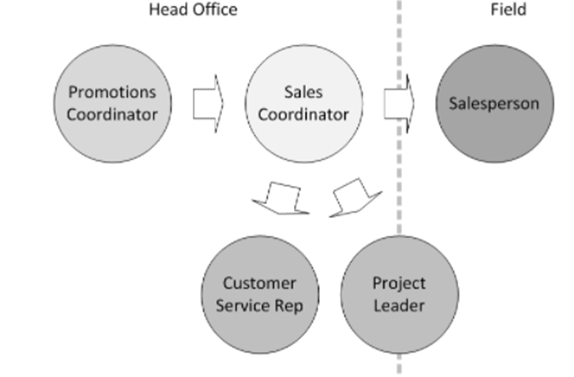
This means that, in order to prosecute each sales opportunity, the sales coordinator will break the opportunity into a series of activities and allocate each activity to one or more of these resources, in accordance with the routing specified in the opportunity-management workflow.
The client’s perspective
It’s easy to see that this model is quite ordered and logical from the organization’s perspective: but what about the client? In asking our clients to interface with multiple people, haven’t we just made their worlds more complex?
It’s true that in this model, clients will interface with four people (sales coordinator, salesperson, project leader and customer-service representative).
It’s also true that, today, most clients ask for – and most organization’s strive to provide – a single point of contact. However, reality is a little more complicated than this.
It’s a mistake to commence this discussion with an assumption that the traditional model delivers good customer service. It simply doesn’t.
It’s also a mistake to take clients’ claim that they’d rather have a single point of contact at face value. In practice, clients can be quite aggressive in seeking-out relationships with other individuals if they sense this is in their best interest.
My experience is that the following statements are closer to the truth (particularly in major-sales environments):
- Clients don’t mind multiple points of contact, but they want a single conversation. In other words, they will willingly speak with multiple people within your firm as long as they do not have to repeat themselves.
- If clients have a choice between dealing with a single generalist and multiple specialists, they would rather speak with specialists.
- Although we talk about the client as if this were a single entity, in most cases, there are multiple people client-side involved in the purchase and consumption of your products.
You will discover that this new model provides a vastly better quality of service, provided you ensure that:
- There is a clear delineation of the responsibilities of the four parties with whom clients interact
- Sales coordinators (who are planning all opportunity-management activities) and CSR’s are in close communication with one another
Creating a powerhouse CST
- Ensure sufficient capacity and capability
- The importance of slack
- Checklists
- Divide responsibilities
- Maintain a big front line
- Quarantine your experts
- Do ALL work in either ERP or CRM
- Confiscate notepads & post-it notes
- Log every case and every activity
- Get a global view of all work
- Aggregate cases from multiple systems
- Calculate actual lead times in net-work-hours
- Determine target case lead times
- Put organisations view of case performance on the wall
- Supervise your team
- Get a good supervisor
- Institutionalize daily, 20-minute max, stand-up WIP meetings
Extreme Ownership
https://learn.arborgreen.net.au/knowledge/extreme-ownership
Extreme Ownership: https://www.youtube.com/watch?v=u-kyRZLE3hE
Calling Out Poor Performance vs Extreme Ownership: https://www.youtube.com/watch?v=EyTZCFpaXOg
Ted Talk - Jocko Willink: https://www.youtube.com/watch?v=ljqra3BcqWM