![Arborgreen - LGreen - RGB - Lrg.png]](https://learn.arborgreen.net.au/hs-fs/hubfs/AG%20-%202023%20Branding%20Collateral/AG%20-%20Logo%20(Light%20Green)/Arborgreen%20-%20LGreen%20-%20RGB%20-%20Lrg.png?height=40&name=Arborgreen%20-%20LGreen%20-%20RGB%20-%20Lrg.png)
...that's from Eisenhowers address to the Century Association in 1961.
This one is from his in 1954 “I have two kinds of problems, the urgent and the important. The urgent are not important, and the important are never urgent.”
Stephen Covey re-created Eisenhower's insights; this framework for prioritization helps you combat the “mere-urgency” effect (more on that later), eliminate time-wasters in your life, and create more mental space to make progress on your goals.
Try the Eisenhower Matrix if you...
-
Find yourself running around putting out fires all day (figuratively speaking)
-
Are busy but don’t feel like your work has a high impact
-
Have long-term goals but no time or energy to make progress on them
-
Have a hard time delegating and/or saying no
-
Want to be the president of the United States (hey, it worked for Eisenhower)
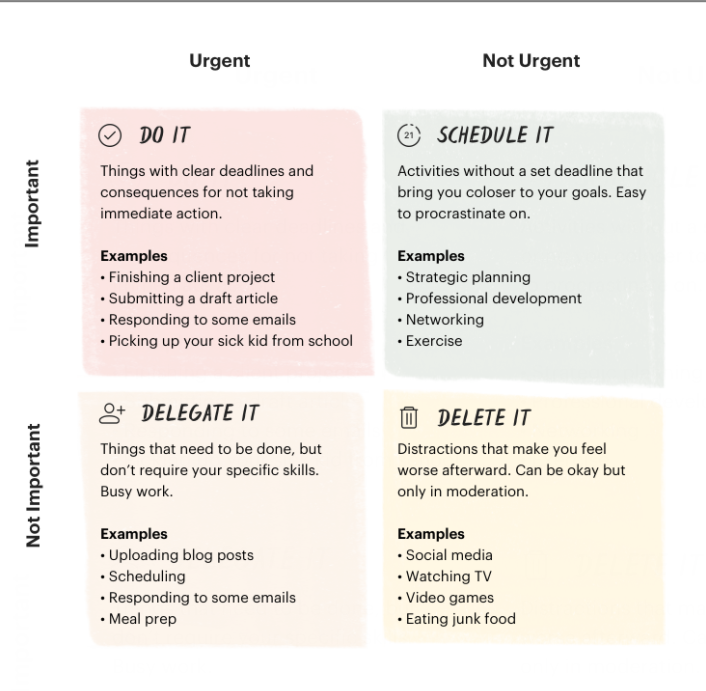
Stephen Covey breaks it down like so:
Urgent matters are those that require immediate action. These are the visible issues that pop up and demand your attention NOW. Often, urgent matters come with clear consequences for not completing these tasks. Urgent tasks are unavoidable, but spending too much time putting out fires can produce a great deal of stress and could result in burnout.
Important matters, on the other hand, are those that contribute to long-term goals and life values. These items require planning and thoughtful action. When you focus on important matters you manage your time, energy, and attention rather than mindlessly expending these resources. What is important is subjective and depends on your own values and personal goals. No one else can define what is important for you.
Quadrant 1: Urgent & Important
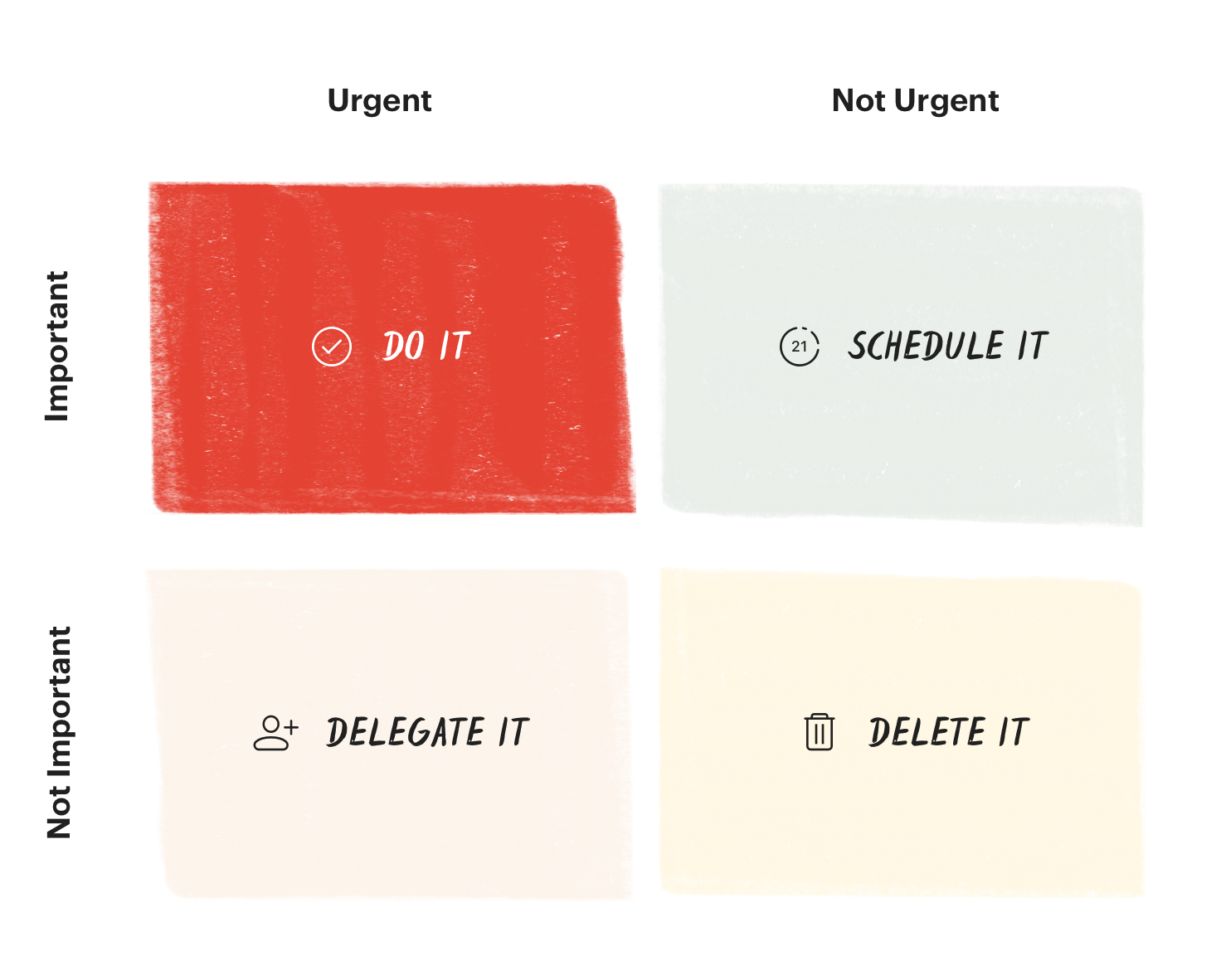
Urgent and Important tasks demand you take action quickly. These items typically have visible deadlines and consequences for stalling on taking action. Most often, these are either things that were sprung on you from an external source or things that you put off until faced with a looming deadline. Either way, they require a crisis mode response.
For example:
-
Covering a project for a colleague out sick
-
Car stalls on the highway
-
Sink springs leak and floods your kitchen in two feet of water
-
Clients come to you with a pressing problem
-
A last-minute deadline is assigned to you
Quadrant 1 tasks are inevitable. Even if you never procrastinated (which is an impossible ask), there will always be something beyond your control. However, the problem comes when you focus on these unexpected or deadline-driven tasks to the exclusion of long-term goals that are important to you.
Covey cautions that spending too much time on Quadrant 1 tasks can lead to increased stress, burn out, and the sense that your days are out of your control. Spending all day putting out fires will quickly rob you of energy and passion for your work, and may make it easier to settle into mindless escapism found in Quadrant 4.
Quadrant 2: Not Urgent & Important
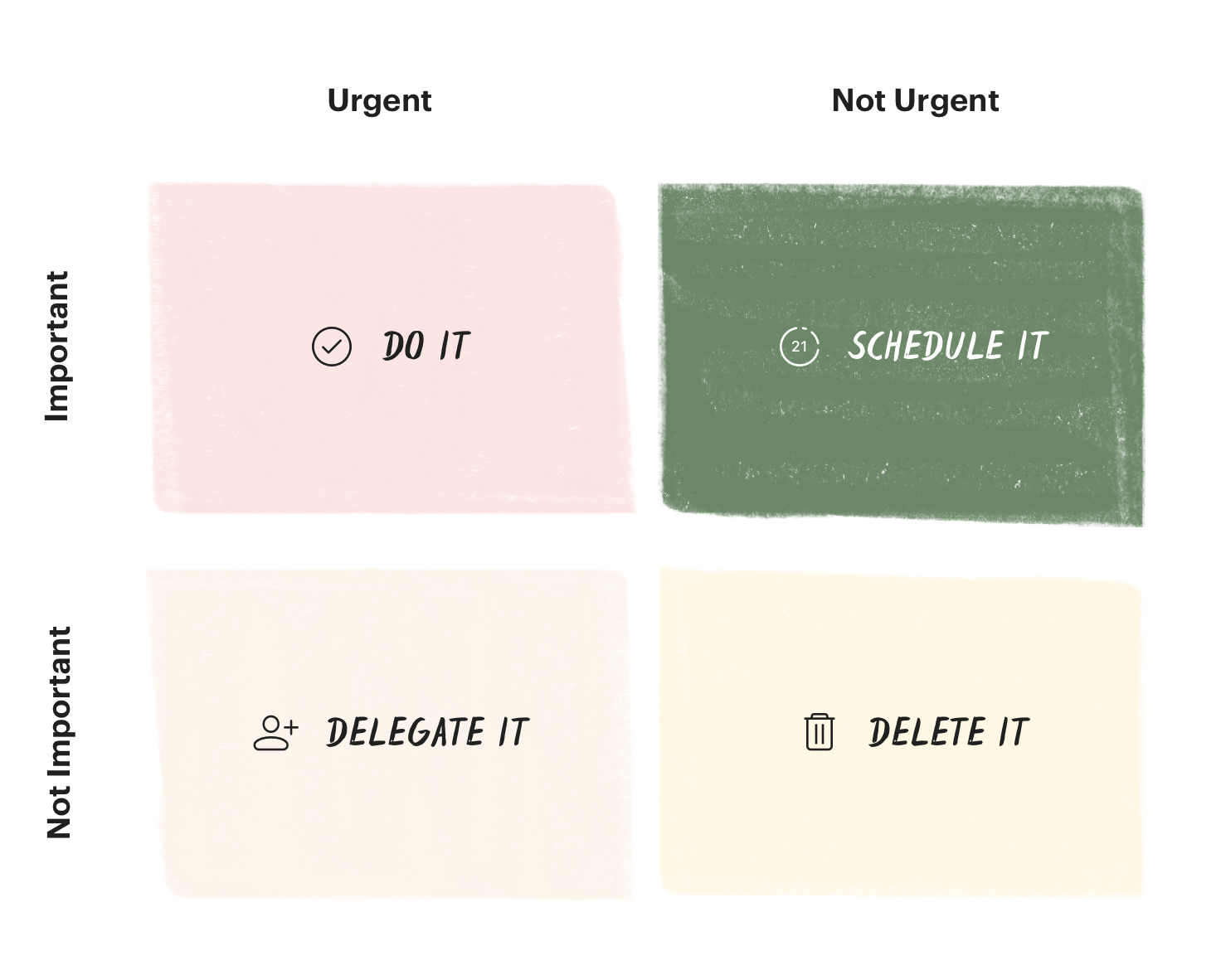
Not urgent, but important tasks are the activities that help you achieve long-term goals. These may not have a deadline (or even an end date) so it is easy to put them off in favor of more urgent tasks. However, these tasks have a much greater effect on your long-term effectiveness in completing your goals.
Examples:
-
Planning for long and short-term projects
-
Regular chores or maintenance projects
-
Professional networking and personal relationship building
-
Learning a new skill, keeping up with current research in your field, attending educational events
-
Exercise and routine healthcare
Covey says that Quadrant 2 is the sweet spot of personal time management. This is the spot where you are focused not on problems (as with Q1) but on opportunities and growth. Living from this quadrant of the matrix means that you are proactive and prioritize activities that grow your skills and energy, and contribute to accomplishing meaningful goals. Quadrant 2 is where “deep work” happens because you are largely freed of pressing distractions.
By attending to Q2 consistently, you decrease the number of pressing problems that pop up in Q1. Living in Q2 means that you can create a plan to complete projects and avoid possible problems. For example, if you keep putting off completing routine car maintenance, you may pay for it later when your car stalls out.
Do you manage other people?
Dig deeper
Do you manage other people? Learn how you can help your team spend more time in quadrant 2 too.
Quadrant 3: Urgent & Not Important
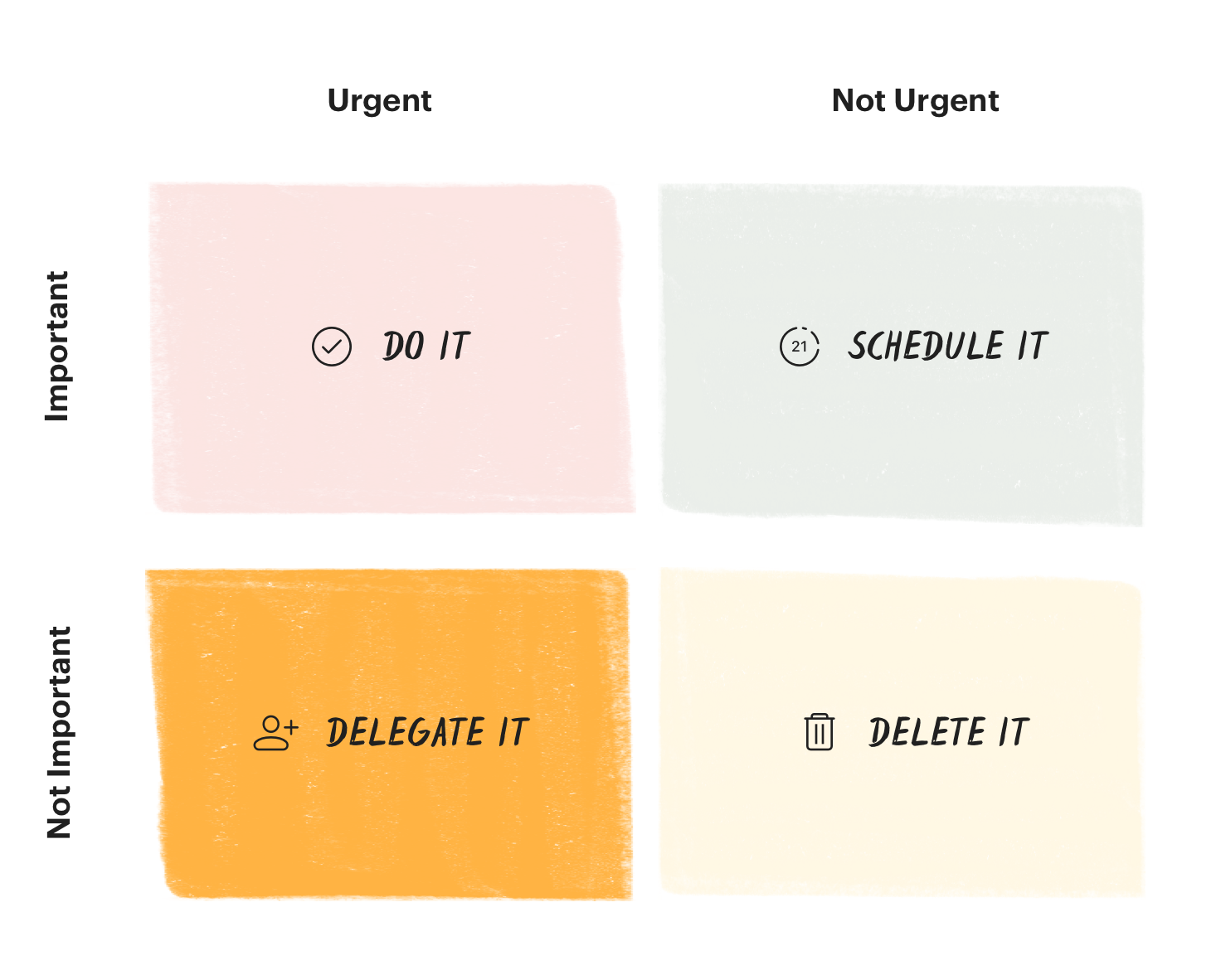
Urgent but Not Important tasks are best described as busy work. These tasks are often based on expectations set by others and do not move you closer to your long-term goals.
Examples:
-
Unnecessary interruptions from coworkers
-
Checking your phone or email whenever it goes off
-
Responding to certain texts, emails, or social media messages
-
Acting on coupons or limited time offers
-
Some meetings
Quadrant 3 is where the mere urgency effect lives. The drive to complete tasks because of real or assumed deadlines means you take on tasks that aren’t actually meaningful to you. Given that Q3 tasks are urgent but typically related to someone else's priorities, spending too much time in this square can feel like you are doing things you should do rather than what you want to do. Focus on Q3 tasks may make you feel like you are not living up your larger life goals or don’t have control over your day-to-day life.
Covey suggests delegating as many Q3 tasks as possible. Can you have someone else take those meeting notes? Can you get your groceries delivered instead of going to the store? Can you empower your children to do the dishes? Can you hire a digital assistant to schedule family doctor visits? Is there anything in your life you can automate?
If you can’t delegate these tasks, try to keep them from taking over your day:
-
Turn off notifications on your phone and computer when working
-
Be clear with others about how much time you can spend on a given task
-
Save Q3 tasks for times when you are very low on energy rather than putting them first thing in the morning
-
Negotiate your workload with your boss
Dig deeper
For more tips on getting out of Q3, learn how to Vanquish Busywork and Spend More Time on What Matters.
Quadrant 4: Not Urgent & Not important
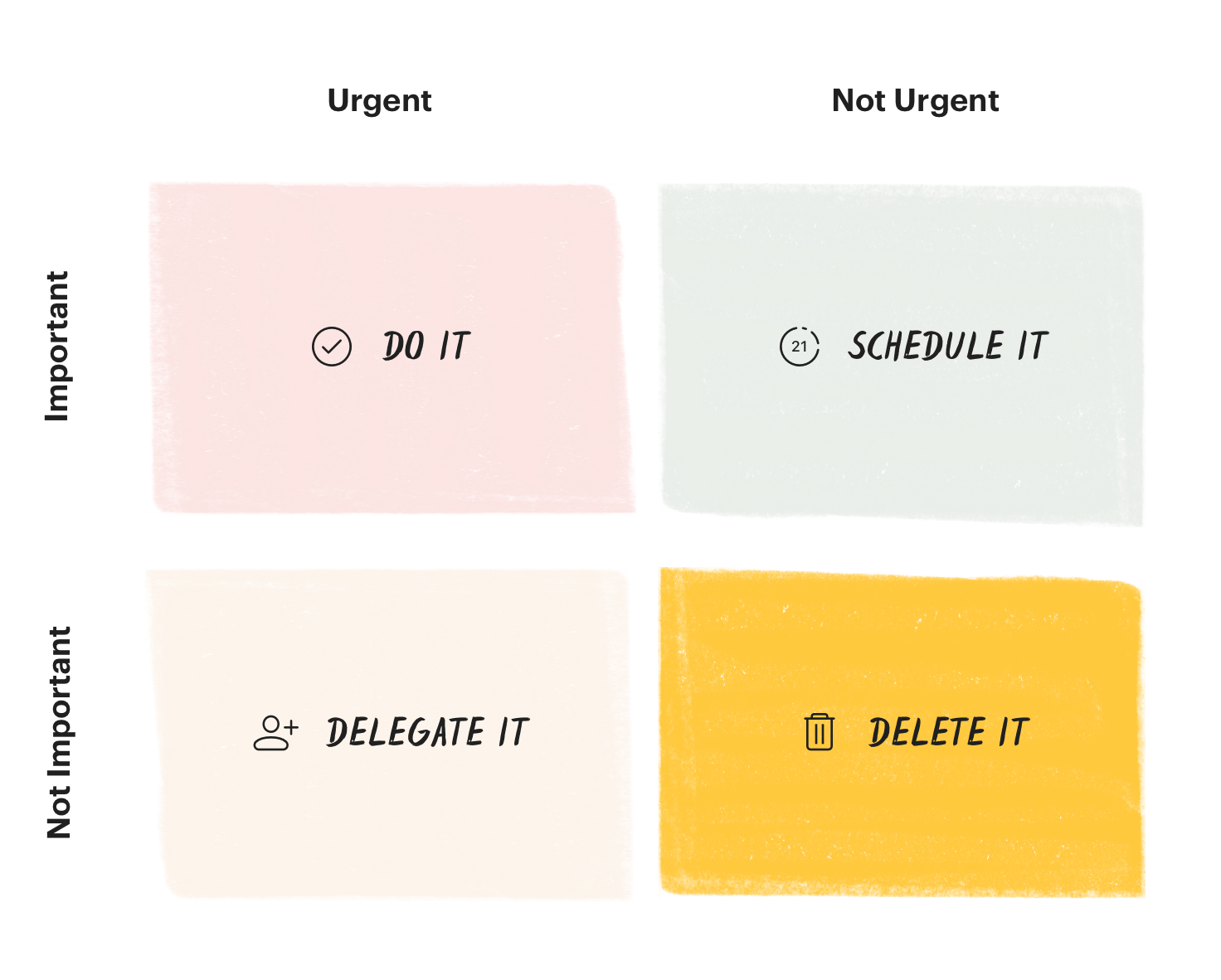
Not urgent and not important tasks are time-wasting activities that should be ruthlessly cut out. These activities don’t contribute to progress on your goals but can end up taking over large chunks of time.
Examples:
-
Watching TV for hours
-
Mindlessly refreshing social media and scrolling
-
Avoidance activities such as sorting and organizing email rather than answering it
-
Excessive shopping or online browsing
Quadrant 4 is the quadrant of excess and immediate gratification that ultimately leaves you feeling unfulfilled.
Don’t get me wrong we all need some leisure time. Eisenhower himself was a well-known bridge player — even playing nightly up to D-Day — and was famously criticized for his many golf trips while in office. The key is that these activities were a balance for the many stressful aspects of being a political leader. However, if you're not intentional about it, the way you spend your downtime can actually drain your energy, passion, and creativity.
A recent study published in the Journal of Applied Psychology found that how employees spend their off-job leisure time is a strong predictor for how much energy and positivity they expressed the following workday. Employees who engaged in self-mastery activities such as exercise or volunteering were more motivated the following day. Employees who relaxed with yoga, meditation, or by listening to music approached the workday more calmly.
Employees who engaged in distraction activities to avoid or ignore problems, like watching excessive TV, did show a renewed positivity the following workday. However, with continued use of distraction their moods and motivation worsened as the week continued. In other words, distraction in moderation was ok, but habitual distraction resulted in less work satisfaction overall.
If you spend a lot of time in Q1, invest time in planning to anticipate and prevent problems:
-
Next step: Organize a weekly or even monthly plan around your current goals and deadlines. At the end of each week, do a weekly review. Reflect on how well your plan worked and adjust for the next week. If most of your Q1 tasks come from external sources, strategize on how you can better plan and anticipate them. You may need to develop a more proactive workflow with a colleague or client, or talk to your boss about rebalancing an excessive workload. If there’s a particular client who’s creating a lot of Q1 tasks, the work may not be worth the stress.
If you spend your time in Q3, delegate, eliminate, or limit the amount of time you spend on these tasks:
-
Next Step: Strategize and write out specific steps on how you’ll limit these tasks. Can you delegate them? Can you just say no? Can you batch these types of tasks together in a single afternoon during your week? Can you have an open discussion with your boss about just how much time you’re spending on “busywork”? Schedule time in your week to take these steps.
If you spend your time in Q4, you may be stuck in a rut, stressed, or avoiding a problem:
-
Next Step: Use your time tracking to identify the biggest time wasters and strategize on how to avoid or limit them. Develop a plan to overcome procrastination before you're tempted to procrastinate. Remember, it’s ok to just relax sometimes, but activities in this quadrant have diminishing returns when used excessively.
As you shift your priorities toward quadrant 2, keep using the Eisenhower Matrix to know what you should be working on day to day.