![Arborgreen - LGreen - RGB - Lrg.png]](https://learn.arborgreen.net.au/hs-fs/hubfs/AG%20-%202023%20Branding%20Collateral/AG%20-%20Logo%20(Light%20Green)/Arborgreen%20-%20LGreen%20-%20RGB%20-%20Lrg.png?height=40&name=Arborgreen%20-%20LGreen%20-%20RGB%20-%20Lrg.png)
You love to give advice. It’s easy when you hear someone around you mention a struggle they’re having to just jump right in there and start trying to solve it. But how often have you paused to think about how much more you’re talking than them? Or if you’re even solving the right problem?
Sadly, when it comes to helping others, most of us do way more talking than listening. This is bad because it means we’re usually not even solving the right problem. Or worse, your proposed solution isn’t actually helpful for their specific situation and needs.
You can tell whether a man is clever by his answers. You can tell whether a man is wise by his questions.
Naguib Mahfouz
Humility is the best weapon against your advice monster’s “I’m better than the other person” DNA. It doesn’t mean you know nothing, being meek or diminishing yourself to worthlessness. Humility means having your feet sufficiently planted so you know your strengths, weaknesses and wisdom surrounding you. By being humble, you control less and influence more than you realize.
You are important, and at the same time not that important.
Two reasons why your Advice doesn’t work:
-
You solve the wrong problem
-
You’re proposing a mediocre solution
Impact of Advice:
-
It demotivates the advice-receivers
-
It overwhelms the advice-givers
-
It compromises team effectiveness
-
It limits organizational change
There are three personas of your Advice Monster
- Tell-It
- Save-It
- Control-It
Your Tell-It monster is the most frequent offender and also the loudest. It tries to make you think that it’s your job to have an answer. Recognition and success only come from sharing in the mindset of this demon. It likes the spotlight, comes when you don’t have a lot of time, and makes you think that you know best.
The Save-It monster is a little less outgoing but no less harmful. When you’ve got this costume on, you think that you have to try to help or everything will fall apart. You’re responsible for everyone and everything, including outcomes. It’s common in times of conflict, disguises itself as “being helpful,” and gets you to think you have the most authority.
Your Advice Monster’s last persona is Control-It, which tricks you into thinking you have to stay in control always, no matter what. It seduces you with the idea that it’s possible to handle everything yourself and won’t let you share power. This one usually has a hard time letting go, comes with megalomania, and makes you think you’re the only thing in the way of chaos.
Your voice isn’t the best voice, let alone the only one.
The key to not falling to an advice trap is to know your voice isn’t the only voice and, in most cases, not certainly the best voice. Knowing so give you access to a deeper sense and understanding of the real situation objectively.
Slow down the rush to give advice.
The definition of coaching doesn’t say ‘never give advice’ or ‘only ask questions’. Advice-giving has its place in your life and that it is usually an over-developed muscle. Perhaps, what we all need to focus on is our underdeveloped muscle – commonly known as the ‘curiosity’.
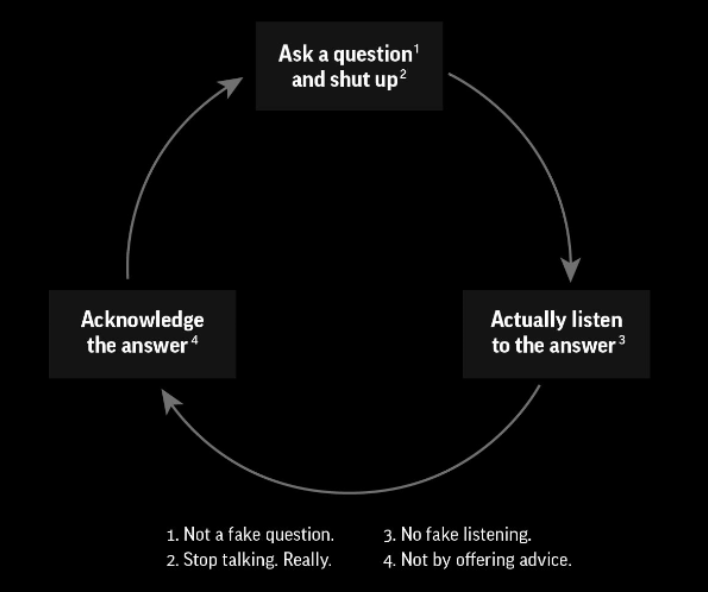
8 keys to asking a question well
- Cut the intro and ask the question.
- Ask one question at a time.
- Skip the rhetorical questions (they’re advice with question marks tacked on).
- Ask questions starting with ‘what’.
- Get comfortable with silence.
- Listen to understand.
- Acknowledge the answers you get.
- Use any channel to ask a question.
When people tell you their challenges, don’t give advice right away.
Instead, stay curios a little bit longer and help them uncover the real challenge underneath. Questions like “what else?”, followed by “what’s the real challenge here for you?” are your best friends to unearth the root cause.
When people talk endlessly about a person/situation…
Don’t fuel the conversation and spend the next hour talking about that person. Michael puts it beautifully – “don’t coach the ghost”. Rather, shift the focus back to the person you’re coaching. Say something like “This sounds hard/tricky/difficult… But I’m interested in how this is hard for you.”
A ghost isn’t always a person. It can also be a situation. Regardless you can deploy the same tactic as you do with the people. Ask “What’s the real challenge here for you?” Put weight on last two words “for you”.
When people go down the conversation rabbit hole…
Say something like “I might be dead wrong here, but it feels like we might not yet be on the real topic. Is that just me, or do you feel it too?”. When they say no, your reply could be “You might be right, but let me test something with you. And again, I may well be barking up the wrong tree here. But could the topic be the thing we should be looking at?”
You can also say like this. “I’m just going to stop you for a moment. I can hear there’s a lot going on. In the interest of time, can we force the issue here?” Then ask, “To get to the bottom line, what’s the real challenge here for you?”
When people start pop-corning problems…
When people bring up a multitude of problems and conversation is getting out of control, don’t pick the challenge you think is fastest or easiest to solve for them. Get the other person to say out loud what’s going on “We can solve only one of these at a time. Which feels like the real challenge here for you?”
When people see the real challenge for them…
Two things can happen. Either they’ll know what they need to do or they won’t. If they don’t know what to do immediately, it’s your job to bridge the situation by saying “We seem to have found the real challenge. Now. how can I help?”. Let them tell you what they need and then, help them come up with their own potential ideas for solution.
Use TERA to create safe space for people.
Tribe – Are you with me?
Expectation – Do I know what’s about to happen?
Rank – Am I less important than you?
Autonomy – Do I have a say in this?
Understand how people rank alongside these four elements because they manifest in specific things you should say and do to make the other person feel safe.
Think of TERA as a music mixing board. When producing music, you need to balance the treble and bass and vocals and everything else. Same way, only when picking the right combination of tactics and strategies, you can increase TERA, seal the exists and make your interactions irresistible.
To increase the other person’s ‘Tribe’ quotient…
Utter small words of encouragement such as uh-huh, yes, nice, great, lovely, excellent, spot-on. Look for opportunities to say ‘we’ and ‘us’. Make your body language count such as nodding your head and raising your eyebrows quickly all signal enthusiasm and agreement.
To increase the other person’s ‘Expectation’ quotient…
Use numbers, say like “We’ve got X things to cover. We want to come up with X ideas.” Use time, say like “Let’s spend next X minutes or so finding the real challenge here. We’ve got about X minutes left for the conversation.”
To increase the other person’s “Rank” quotient…
Let them go first. Say like “I’ve got some thoughts, but before I share my ideas… what are your first thoughts?” and follow up with “What else?”. Lower your rank, say like “You’ll know this better than me…”, “You’re best placed to understand this…”, “Here’s my best guess…”, “I could be wrong, but let me suggest…”. Remove physical barriers such as taking off a tie or jacket, rolling up your sleeves to level down to where the other person is.
To increase the other person’s “Autonomy” quotient…
Ask questions as simple as “What’s on your mind?”, “What do you want?”.
You can’t be a good writer unless you’re a good reader.
Likewise, you can’t be a great coach without being a great coachee. Be willing to be coached no matter where you are in life right now. Doing so will help you stay grounded and in part, tame your advice monster.
https://waiyancan.com/the-advice-trap-summary/